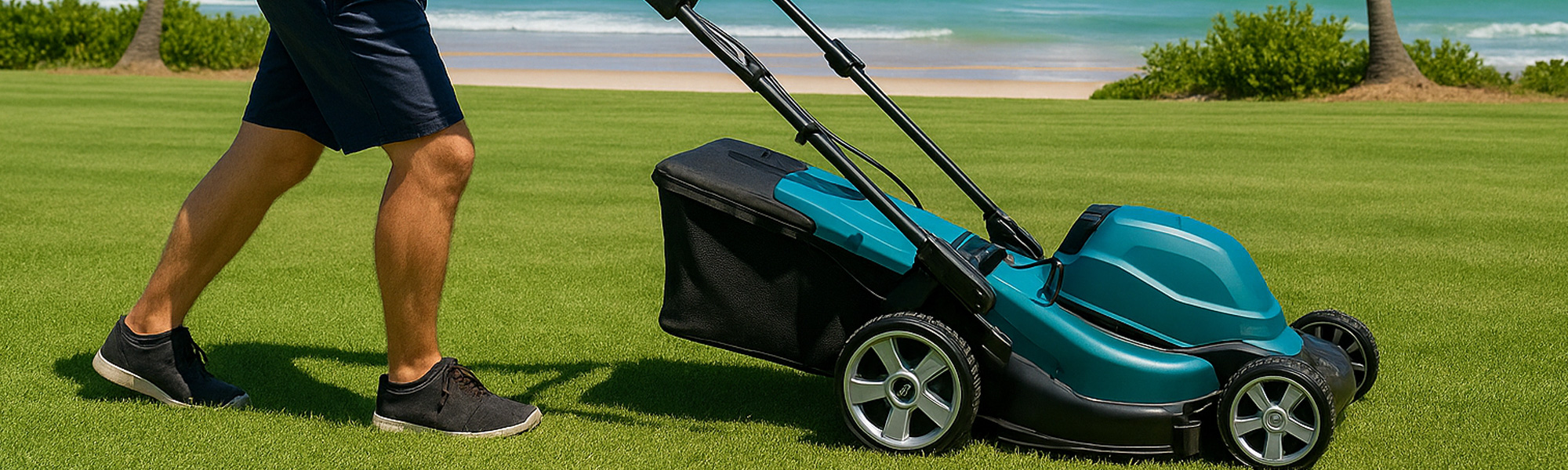
For decades, petrol mowers dominated suburban lawns because there was no realistic alternative. That has changed completely. Modern electric mowers are not a compromise or a niche option anymore. They outperform petrol models in everyday use, they suit how people actually maintain lawns today, and they remove a long list of frustrations that homeowners quietly tolerated for years. The shift is not about environmental virtue alone. It is about practicality, reliability, cost, comfort, and how mowing fits into real life rather than an idealised weekend chore.
Immediate Power Without the Start-Up Ritual
One of the most underestimated advantages of electric mowers is how instantly usable they are. A petrol mower demands a ritual every time you want to cut the grass. Fuel levels must be checked, choke settings guessed, pull cords yanked, and engines coaxed into life. After periods of storage, this can turn into a frustrating exercise that delays the job before it even begins.
Electric mowers eliminate all of that. Corded models start the moment power is applied. Battery models start with a button press. There is no warm-up, no stalling, and no repeated attempts to restart after stopping to move obstacles. This immediacy changes mowing behaviour. Lawns are more likely to be trimmed when they need it, not postponed until growth becomes unmanageable. The mower feels like a tool you can use on demand rather than an engine you have to negotiate with.
Lower Ongoing Costs and Predictable Ownership
Petrol mowers appear cheaper upfront in some cases, but they carry a steady stream of ongoing costs that electric models largely avoid. Fuel, oil, spark plugs, air filters, carburettor cleaning, and periodic servicing all add up over time. Even infrequent use does not spare petrol engines from degradation, because fuel goes stale and internal components suffer when machines sit unused.
Electric mowers have far fewer consumable parts. There is no fuel to buy, no oil to change, and no ignition system to maintain. Battery replacements are the main long-term cost for cordless models, but modern lithium packs last for many years and often share compatibility across other garden tools. Over the life of the mower, the total cost is lower and more predictable, especially for households that do not mow on a strict weekly schedule.
Quieter Operation That Changes Where and When You Mow
Noise is one of the most immediate differences between petrol and electric mowers. Petrol engines generate a sharp, mechanical sound that carries well beyond property boundaries. This limits when mowing feels socially acceptable and often forces people into narrow time windows.
Electric mowers operate at significantly lower noise levels, with a smoother sound profile that does not travel as aggressively. This has practical consequences. You can mow earlier in the morning or later in the afternoon without worrying about complaints. You can stop and start freely without restarting an engine that announces itself to the whole street. For households near schools, apartments, or close-set neighbours, this alone can justify the switch.
Less Physical Fatigue Over a Full Lawn
Mowing is not just about cutting grass. It is about pushing, turning, lifting, and manoeuvring a machine across uneven ground. Petrol mowers are heavier because of their engines, fuel tanks, and reinforced frames. That weight becomes noticeable over a full session, especially on sloped blocks or when turning frequently around garden features.
Electric mowers are generally lighter and better balanced. The absence of a combustion engine allows designers to distribute weight more evenly, making the mower easier to steer and pivot. Battery models in particular feel more agile, reducing strain on arms, shoulders, and lower back. This matters not only for comfort but also for safety, especially for older users or anyone mowing in hot conditions.
Cleaner Cutting With More Consistent Blade Speed
Petrol engines vary their output depending on load, engine condition, and throttle response. As grass thickens or dampens, blade speed can drop, leading to tearing rather than clean cutting. This stresses the lawn and can leave a ragged finish that browns at the tips.
Electric motors deliver consistent torque across their operating range. When properly matched to the mower deck and blade, this produces a cleaner cut even as conditions change. Many modern electric mowers also use smart motor control, increasing power automatically when resistance rises. The result is a more even finish, healthier grass, and less need to re-mow missed or poorly cut areas.
Zero Local Emissions and Cleaner Storage Spaces
Petrol mowers emit exhaust gases every time they run. While each session may seem minor, the cumulative effect in residential areas is significant. Beyond air quality, there is also the practical issue of fumes lingering in garages, sheds, and storage rooms.
Electric mowers produce no local emissions. They can be stored indoors without ventilation concerns, and there is no smell of fuel or exhaust clinging to tools and walls. This makes them far better suited to modern homes where storage spaces are often integrated into living areas rather than isolated sheds at the back of the yard.
Reduced Maintenance That Actually Gets Done
Many mower problems stem from neglected maintenance rather than design flaws. Petrol engines demand regular attention, and when that attention is skipped, performance degrades quickly. For many homeowners, this leads to unreliable starting, poor cutting, and shortened lifespan.
Electric mowers dramatically reduce the maintenance burden. Blade sharpening and deck cleaning still matter, but these are straightforward tasks that directly affect performance and are easier to keep up with. With fewer systems to ignore, electric mowers tend to remain in good working condition for longer, simply because there is less to forget or put off.
Better Fit for Smaller and Medium Lawns
The average suburban lawn has shrunk over time, especially in newer developments. Large petrol mowers designed for expansive blocks are often unnecessary for these spaces. Electric mowers, particularly cordless models, are well matched to smaller and medium lawns where agility and convenience matter more than raw engine size.
Battery capacity has improved to the point where most households can mow their entire lawn on a single charge. For larger properties, spare batteries or higher-capacity models solve range concerns without reintroducing the drawbacks of petrol. This scalability makes electric mowers flexible rather than limiting.
Safer Operation With Fewer Failure Modes
Combustion engines involve heat, flammable liquids, and high-speed mechanical parts operating under pressure. While generally safe when maintained, they introduce more ways for things to go wrong. Fuel leaks, hot surfaces, and mechanical failures are all inherent risks.
Electric mowers simplify the system. There is no fuel to spill, no exhaust to burn, and fewer moving parts overall. Modern designs incorporate multiple safety interlocks, immediate blade stopping, and thermal protection for motors and batteries. For families and shared households, this reduced risk profile is an important advantage.
A Better Match for How People Live Now
Perhaps the strongest argument for electric mowers is that they align with contemporary lifestyles. People want tools that work immediately, require minimal upkeep, and integrate cleanly into their homes. They want flexibility rather than obligation, and reliability rather than mechanical rituals.
Electric mowers deliver on these expectations. They turn lawn care into a straightforward task rather than a technical exercise. As battery technology and motor efficiency continue to improve, the remaining reasons to choose petrol are steadily disappearing. For most homes, the electric mower is not the future of lawn care. It is already the better choice today.
Taking It Further With Automatic Electric Lawnmowers
Robotic lawnmowers remove mowing from your routine almost entirely. Instead of cutting infrequently and aggressively, they trim small amounts of grass on a regular schedule, keeping lawns at a consistent height and reducing stress on the turf. The result is a more even, healthier lawn without the peaks and troughs of manual mowing.
Once installed, they operate on their own. The mower leaves its charging dock, cuts within its set area, and returns to recharge without supervision. They are extremely quiet, use very little power, and can run at flexible times without causing disruption. Maintenance is minimal, limited mainly to blade changes and basic cleaning.
While the upfront cost is higher, automatic electric mowers suit homeowners who want reliable, continuous lawn care with almost no ongoing effort. For many modern homes, they represent the most hands-off and consistent way to keep a lawn under control.
You might also like






Disclaimer: Every effort has been made to ensure the accuracy of the information provided, but we make no guarantees regarding its completeness or reliability. The data is presented for general informational purposes only and does not constitute financial, investment, or legal advice. We are not liable for any errors, omissions, or consequences arising from its use. Users should verify details with relevant sources and seek professional advice where appropriate for the most accurate and up-to-date guidance.