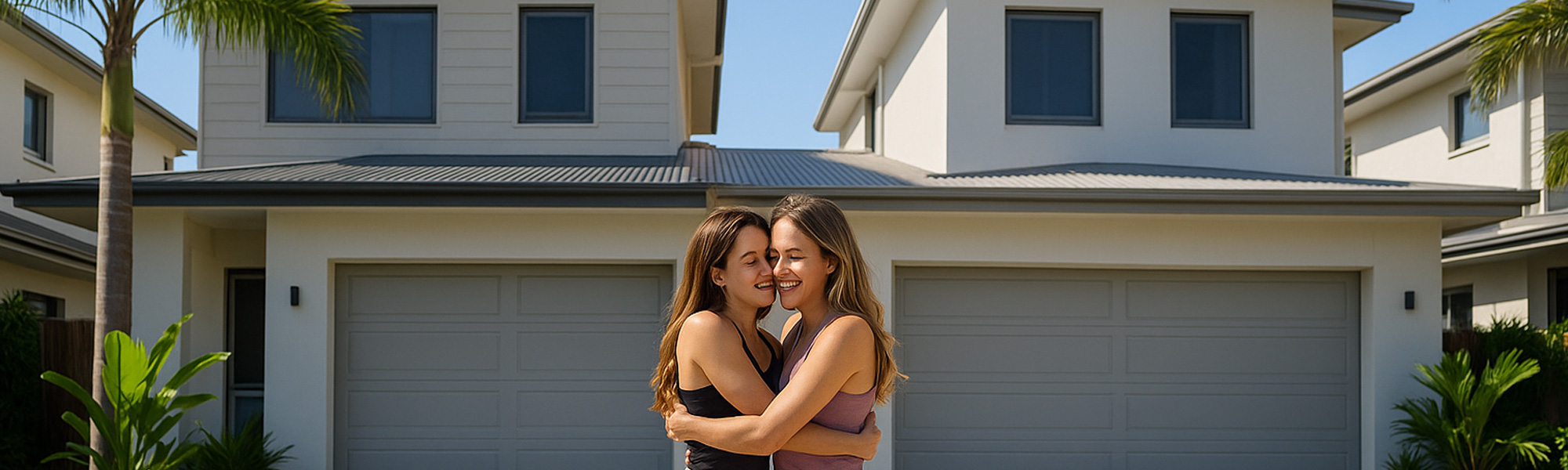
On the Gold Coast, the idea of buying or building next to family or close friends usually starts as a constraint, not a preference. People arrive at it because conventional options stop working. A shared house creates friction. Living a few streets apart turns into living a few suburbs apart once availability, budgets, and timing are factored in. Side-by-side dwellings sit in the narrow space between those two failures.
This is not about lifestyle alignment. It is about solving practical problems: childcare coverage, ageing parents who need proximity but not supervision, adult siblings coordinating support, or long-term friends who want reliability without cohabitation. The Gold Coast market makes this achievable in ways many cities do not, but only if the decision is approached with clarity.
Situations Where Side-By-Side Ownership Actually Makes Sense
This approach is most useful where proximity provides daily value rather than occasional convenience.
Parents and adult children are a common example. The parent wants independence and dignity, not a bedroom at the end of a hallway. The adult child wants availability, not responsibility for a shared household. Two dwellings next to each other allow informal help without formal dependence. Either party can sell, lease, or change circumstances without unravelling the other's position.
Siblings often reach this point after dealing with shared caregiving or inheritance decisions. Rather than pooling funds into one complex structure, they choose adjacent dwellings so assets remain cleanly separated. This avoids disputes later when circumstances diverge.
Long-term friends typically arrive here through apartment purchases. Two units in the same building allow proximity without shared decision-making. This works best where both parties value independence and predictability over control.
What these situations have in common is that proximity has operational value. If the relationship does not benefit materially from being next door, the arrangement rarely justifies the complexity.
Duplexes On The Gold Coast And Why They Are Often Chosen
Duplexes are a natural fit for side-by-side living on the Gold Coast because they already sit comfortably within local development patterns. Many suburbs contain older houses on blocks that meet minimum lot size and frontage requirements for dual occupancy. Replacing one dwelling with two is familiar to planners, builders, and lenders.
The main advantage of a duplex is control. Both households can influence layout, orientation, storage, parking, and outdoor areas before construction begins. This matters when needs differ. One household may require single-level living or wider doorways. The other may prioritise extra bedrooms or a study. Duplex design allows those differences to be resolved structurally rather than negotiated daily.
Privacy is another factor. A well-designed duplex can feel closer to a detached home than an apartment. Garages, stairwells, laundries, and storage rooms can be placed between dwellings to reduce noise transfer. Outdoor spaces can be oriented away from each other rather than treated as shared zones.
The downside is coordination risk. Duplex projects involve approvals, cost escalation, and construction delays. When two households are involved, misalignment around budgets or finishes can quickly become personal. This risk is manageable, but only if acknowledged upfront.
Adjacent Apartments And When They Are The Better Option
Adjacent apartments solve a different problem. They eliminate development risk entirely.
The dwellings already exist. Titles are separate. Finance is straightforward. There is no coordination around builders, materials, or timeframes. This suits buyers who want certainty more than control.
On the Gold Coast, this approach works best in low-rise or mid-rise buildings where layouts are generous and ownership is predominantly owner-occupier. Two apartments on the same level or in the same vertical stack provide proximity without enforced interaction.
However, apartments introduce constraints that matter more when the neighbour is someone you know well. Body corporate rules shape how the property can be used. Acoustic separation determines whether daily life feels comfortable. Balcony placement affects privacy. Lift and car park layouts determine how often you cross paths unintentionally.
Choosing adjacent apartments without understanding these details often leads to frustration. The building must support parallel living, not constant interaction.
Planning And Zoning Constraints That Matter In Practice
On the Gold Coast, planning controls determine feasibility long before relationships do.
For duplexes, zoning dictates whether dual occupancy is permitted, the minimum lot size, site coverage, height limits, and parking requirements. Two sites on the same street can fall under different overlays and produce different outcomes. Attempting to force a duplex onto a marginal site often results in redesigns, delays, or refusal.
Buyers who succeed usually identify zoning compatibility first and relationship alignment second. This prevents the arrangement from becoming emotionally invested before it is legally viable.
Apartment buyers face fewer planning hurdles, but still need to understand use restrictions. Leasing limitations, renovation approvals, and pet policies all matter when circumstances change. These constraints are not theoretical. They affect resale value and flexibility directly.
Keeping Finances Separate Without Losing Cooperation
Financial separation is not optional in side-by-side arrangements. It is what makes them sustainable.
Each household should borrow independently, hold title independently, and make decisions independently. Even when building together, the structure should assume divergence over time. One party may sell earlier. One may lease their dwelling. One may experience financial stress. The arrangement should allow all of this without requiring consent or cooperation from the other party.
In duplex projects, cost allocation must reflect reality. Differences in orientation, outdoor space, parking, and future resale appeal need to be priced accordingly. Treating unequal dwellings as equal investments creates long-term resentment.
Shared loans and informal agreements introduce risk without delivering meaningful benefit. They undermine the reason most people choose adjacent living in the first place.
Design Choices That Prevent Long-Term Friction
Design determines whether proximity feels supportive or intrusive.
In duplexes, this means managing sightlines, noise transfer, and outdoor use deliberately. Bedrooms should not face directly into neighbouring living areas. Outdoor spaces should not rely on goodwill for privacy. Landscaping is functional, not decorative.
In apartments, party wall construction quality matters. Balcony depth and orientation matter. Shared corridors and lobbies influence how often neighbours encounter each other unintentionally. These details become more important, not less, when the neighbour is family or a close friend.
Good design allows interaction to be chosen rather than imposed.
Living Next Door Without Turning Proximity Into Obligation
Living next door magnifies habits. It does not create them.
The most common problems are small assumptions that accumulate over time. Dropping in unannounced. Expecting availability. Informal borrowing that becomes routine. These issues are more damaging than distance because they blur boundaries.
Successful arrangements treat proximity as convenience, not entitlement. Help is offered, not assumed. Privacy is respected as default. The physical closeness exists to reduce friction, not create obligation.
Many people find that living next door improves relationships compared to shared housing. Separate kitchens, separate routines, and separate standards remove many of the daily irritations that strain goodwill.
Resale, Rental, And Long-Term Flexibility
Side-by-side living should never compromise future value.
Each dwelling must stand on its own merits in the open market. Buyers assess the property, not the relationship next door. Problems arise only when arrangements are informal, poorly documented, or structurally intertwined.
One of the strengths of this approach is adaptability. What begins as two owner-occupied homes can later become a mix of owner-occupier and rental, or two rentals, without structural change. This aligns well with the Gold Coast market, where household needs change faster than housing stock.
What This Actually Is And What It Is Not
This is not a lifestyle concept, a trend, or a social experiment. It is a practical response to how the Gold Coast housing market functions.
Buying or building next to people you trust works when it is driven by real constraints, structured carefully, and designed for independence first. When those conditions are met, proximity becomes an asset rather than a liability.
You might also like




Disclaimer: Every effort has been made to ensure the accuracy of the information provided, but we make no guarantees regarding its completeness or reliability. The data is presented for general informational purposes only and does not constitute financial, investment, or legal advice. We are not liable for any errors, omissions, or consequences arising from its use. Users should verify details with relevant sources and seek professional advice where appropriate for the most accurate and up-to-date guidance.