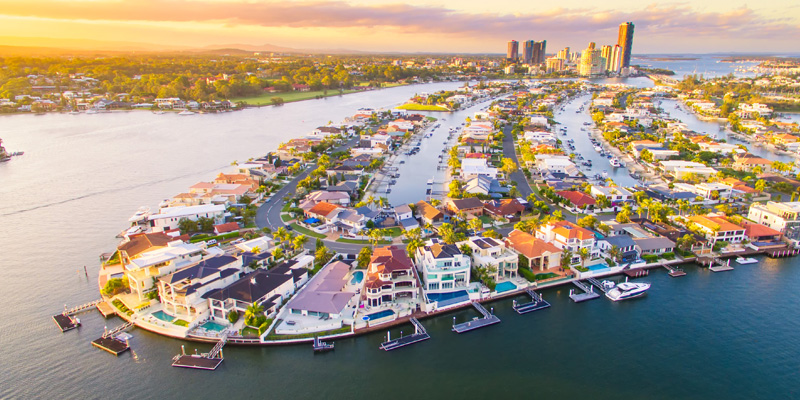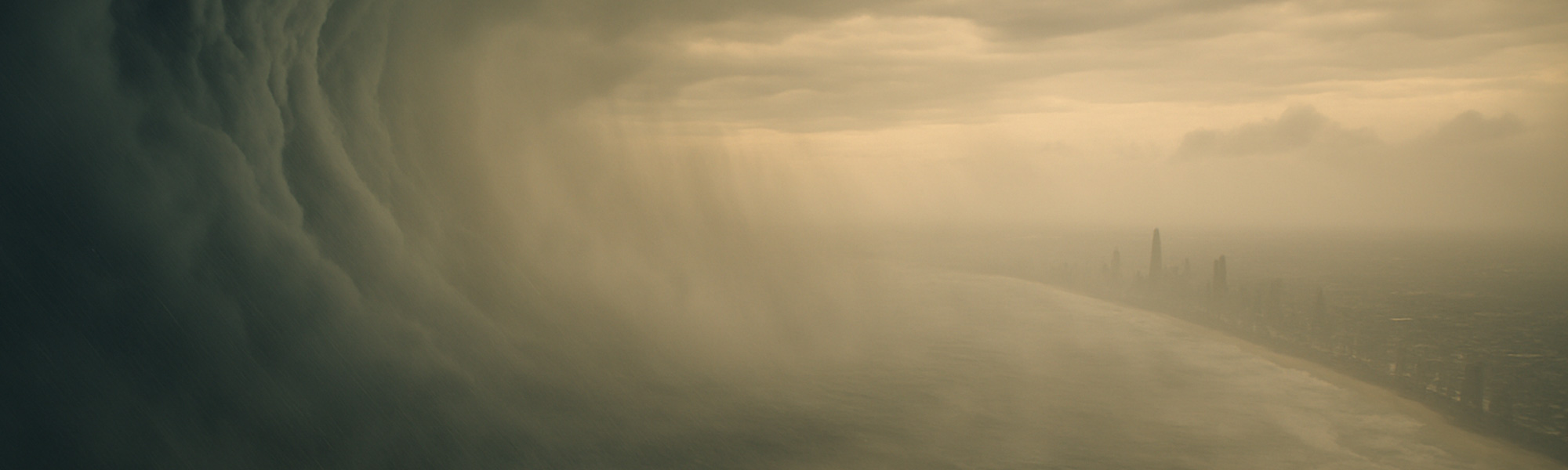
The Gold Coast sits just south of Australia's most historically active cyclone corridor, which means the city enjoys a naturally lower probability of direct landfall. Yet the risk is not zero. The near misses Brisbane and the Gold Coast experienced recently with Tropical Cyclone Alfred in March 2025 were a reminder of how erratic storm tracks can be. Even a moderate cyclone arriving over warm coastal waters can produce wind loads that exceed anything in day-to-day weather.
Australian building codes do not design to average conditions. They design to rare, extreme, statistically modelled events. A high rise on the Gold Coast must be capable of performing under pressures that only occur once in many decades, even if the city never sees a cyclone's eye cross the shoreline. This is why the engineering behaviour during such an event is so important to understand.
Cyclones as a Design Scenario, Not an Exception
Cyclones almost never make a clean landfall on the Gold Coast, but building codes here do not rely on luck. Even when storms curve away or weaken offshore, their outer wind fields often reach the city with surprising force. Engineers therefore treat a cyclone as a legitimate design event, not a far-fetched hypothetical. Every tower constructed in the region must demonstrate performance under rare but extreme wind pressures, rapid pressure cycling, driven rain volumes far beyond daily weather and impact forces generated by turbulent vortices.
This has created a skyline where even older buildings contain layers of structural conservatism, and where newer ones integrate technology derived from aerospace, offshore oil platforms and wind tunnel research. Residents may never notice, but the Gold Coast high-rise inventory is quietly built for events that most cities will never see.
Understanding What Cyclone Wind Actually Is
Cyclone wind is not a giant, uniform blast. It is a three-dimensional rotating system with enormous turbulence. The speed at which the air moves increases with height, meaning the top of a tower receives far more load than the podium. The direction of gusts changes constantly as the storm's eyewall and feeder bands pass, producing rapidly alternating suction and pressure patterns across the façade. These changes occur faster than the human eye can register, but the building feels each one.
Engineers model this using boundary-layer wind tunnels that replicate the behaviour of airflow over oceans and coastal urban landscapes. Instead of relying exclusively on theoretical formulas, scale models are placed inside the tunnel with hundreds of tiny pressure sensors. These sensors record the pressure spikes, suction pockets, corner vortices and torsional moments that occur as the model experiences a fabricated cyclone. The data collected determines not just how strong the façade must be but how the entire structural frame must respond.
The Building as a Vertical Cantilever
Every high rise is essentially a gigantic vertical beam anchored to the ground. During a cyclone, the tower's design intentionally bends, twists and sways in a predictable shape called a deflected mode. This behaviour is not a sign of distress but of functionality. If the structure were perfectly rigid, it would shatter under extreme load. Flexibility allows the building to convert sharp, sudden wind forces into gradual deformation that spreads throughout the height of the tower.
The structural core is the most important element. In older towers it is often a thick reinforced concrete box made from shear walls. In newer towers the core may be thinner but strengthened by ultra-high-strength concrete, perimeter moment frames, outrigger floors and belt trusses. These connections allow the building to distribute force across the entire footprint so no single wall, façade panel or column becomes overloaded. When the wind pushes one side of the building, the outriggers activate and engage far-flung columns to help resist the force. This spreads the load much like a tree uses both trunk and branches to resist bending moments.
Elastic Behaviour Versus Ultimate Behaviour
Cyclone design involves two performance states. The first is the serviceability state where the building behaves elastically and returns to its original position once the storm passes. Engineers model this carefully because occupant comfort becomes relevant at this stage. Excessive sway can trigger seasick sensations even when structural safety remains intact. Most Gold Coast towers are stiff enough that only the most extreme winds produce noticeable sway.
The second is the ultimate limit state. This represents a storm stronger than anything expected within the building's design life. Even here, the structure must remain stable. It may undergo some controlled cracking in shear walls, yielding in reinforcement or temporary stiffness loss, but collapse remains off the table. Australia's codes require extremely conservative safety margins so that even a once-in-several-centuries event cannot compromise the building's stability.
Why a Tower Sways and How Much Movement Is Allowed
Residents often imagine sway as a catastrophic motion, yet in engineering terms it is an elegant energy dissipation mechanism. At the top of a tall Gold Coast building, lateral displacement of several dozen centimetres during a severe cyclone is entirely normal. Floors do not shift individually. They deform as part of a continuous system connected through slabs, columns and the core. The movement you feel is not the building “rocking”. It is a structural system flexing within safe limits.
Engineers calculate natural frequencies for the building and ensure these frequencies do not coincide with the wind's vortex shedding cycle. If they aligned, the building could experience resonance where small wind pulses amplify motion over time. Gold Coast towers are proportionally stockier than the world's super-slender skyscrapers, so resonance is usually avoided through mass and stiffness alone. In a few rare cases, tuned mass damping could be added, but most buildings here achieve adequate comfort performance without it.
The Aerodynamics of Vortex Shedding
When wind flows around a rectangular building, vortices form and release from alternating sides. This creates oscillating forces at predictable frequencies. The shape of the building influences how intense these vortices become. Rounded corners reduce vortex strength. Deep recesses interrupt vortex formation. Some Gold Coast towers deliberately taper, offset balconies or introduce façade irregularities to break up coherent vortices. Engineers test various architectural shapes in the wind tunnel to find the form that naturally resists dangerous oscillation.
Cyclone gusts make vortex shedding more chaotic, but the underlying physics still matters. Vortices try to pull the tower sideways in alternating directions. The structural core counters this by resisting torsion and bending, ensuring the lateral motion never exceeds acceptable bounds.
Internal Pressure Behaviour During a Cyclone
Inside the building, pressure behaviour changes dramatically. Stairwells, lift shafts and risers act like vertical chimneys. If wind infiltrates these spaces through tiny façade gaps or imperfect seals, pressure differentials can develop. In modern towers, stair pressurisation fans and automatic dampers balance these pressures so the doors remain operable and no uncontrolled backdraft occurs.
Lift systems may park at certain floors. Operators may disable normal call functions to prevent doors from opening during pressure surges. Contrary to common assumptions, high rises do not "breathe" in and out with dramatic force during wind events. Instead, they maintain stable internal conditions through engineered pathways that allow safe and controlled air movement.
The Engineering of Cyclone-Resistant Façades
Glass is almost never the weak point of a modern high rise. Laminated glazing contains a tough polymer interlayer that keeps the panel intact even if it cracks. The real engineering occurs at the frame and anchorage level. Window mullions, transoms and anchors must resist enormous suction forces as the storm attempts to pull panels outward. They must also resist positive pressure trying to push them inward from the opposite side.
Modern façade systems undergo cyclic pressure testing replicating the rapid load changes typical of cyclones. They also undergo water penetration tests at pressures far higher than everyday storms. Many incorporate pressure-equalised cavity systems where the internal chamber matches the external pressure, greatly reducing water ingress. Even so, driven rain under cyclone speeds can enter at micro-gaps. This is not structural failure but an extreme-weather limitation of all façade systems.
Older façades, especially single-glazed systems with basic frames, show their age during these events. They may flex visibly or admit water around seals. Bodies corporate frequently commission façade remediation projects specifically because modern standards outperform legacy detailing by a wide margin.
How Wind-Driven Rain Actually Penetrates
Cyclone rain does not fall vertically. It travels almost horizontally and strikes the building as a high-speed fluid. At sufficient pressure, it can overcome the drainage pathways built into standard window frames. Even the best systems allow controlled entry of some water into internal cavities. They rely on gravity and pressure differentials to channel this water safely back outside.
During a cyclone, the external pressure may exceed what the internal drainage path can counterbalance. Water may appear inside sliding tracks or drip at internal junctions. Engineers design these systems so that any water that appears comes in small, predictable quantities. The structure itself remains entirely unaffected.
Foundations and Soil Interaction Under Cyclone Loading
When wind pushes the top of a building, the base tries to rotate. This creates tension in piles at one end and compression at the other. Deep piles resist this through skin friction along their length and end bearing at the tip. Gold Coast towers typically sit on dense sands or sandstone layers that provide excellent resistance. Engineers analyse these soil-structure interactions through finite element modelling to ensure the building cannot overturn even during storms far above typical design conditions.
In extreme scenarios the piles may experience uplift forces, but they are equipped with reinforcement that handles both tension and compression. Even the largest plausible cyclone cannot produce enough overturning moment to cause a high rise with compliant foundations to fail.
Podiums, Carparks and Low-Level Wind Phenomena
Ground-level wind behaviour differs from high-altitude wind. Buildings channel and accelerate winds between them, creating intense gusts that affect podiums and entryways. These forces mainly impact façade elements, roller doors and cladding. They do not threaten the primary structure.
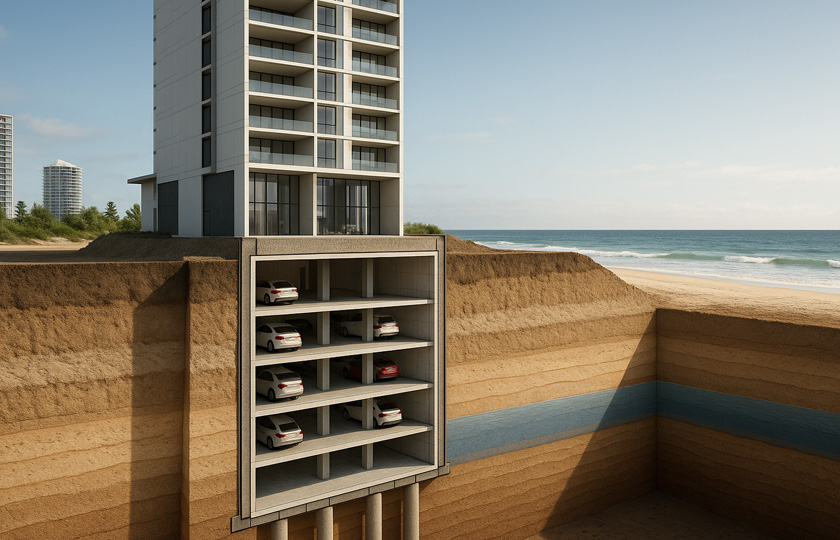
Carparks below ground are shielded from the direct wind field. Their vulnerability comes from water rather than air. Storm surge, high tides and heavy rainfall can place pressure on drainage systems. Nevertheless, the retaining walls of modern carparks are deeply reinforced and designed to withstand significant water pressure and soil movement. Unlike a small basement in a house, a high-rise carpark is built as a structural component of the tower and benefits from the same level of engineering.
Rooftop Equipment and Why It Is Often the Most Vulnerable Component
While the structural frame of a building is nearly impossible to dislodge, rooftop equipment is exposed and lighter. Mechanical units, antennas, water tanks, solar panels and lightning conductors face strong uplift forces during cyclone events. Modern buildings anchor these using high-capacity bolts, brackets and structural pads. Older buildings sometimes rely on historical fixing methods that may not meet current standards. This is why engineers often highlight rooftop equipment as the part of the building most likely to require remediation after a severe wind event.
Any failure here rarely affects the structural integrity of the tower but can create debris that damages glazing or façade elements. Many bodies corporate now undertake rooftop audits before cyclone season even though a direct strike remains unlikely.
Why High Rises Almost Never Collapse During Cyclones
A low-rise house can fail because its roof trusses separate under uplift or because its walls cannot resist lateral loads. High-rise buildings behave differently. They are monolithic reinforced concrete or steel-concrete hybrid structures where all parts transfer loads to each other. There is no discrete weak point such as a single truss connection.
Every part of the building, from the core to the slabs to the piles, contributes to resisting wind. For collapse to occur, a domino series of failures would have to happen in multiple unrelated systems simultaneously. Codes are specifically written to prevent such cascading failure, ensuring that localised damage cannot propagate into structural compromise.
The Post-Cyclone Recovery Phase
When the cyclone passes, the tower gradually returns from its deflected shape to its natural alignment. Engineers then perform systematic inspections. They examine the structural core for cracking patterns consistent with peak load behaviour. They assess façade joints and seals for overstretching or deformation. They check balustrades, rooftop equipment, lift overruns, stair pressurisation systems, mechanical plant rooms and sump pumps. They evaluate water ingress pathways to identify whether any seals require renewal.
None of this implies danger. It simply ensures that the building remains in peak condition for future storms. Even after a rare severe event, Gold Coast towers usually show only superficial or maintenance-level issues.
The Difference Between Older and Newer Towers
Older towers tend to outperform expectations due to their conservative bulk. They feature thicker slabs, heavier cores and simpler load paths. Their stiffness gives them excellent storm resilience, although their façades may show limitations in water resistance or frame flexibility.
New towers use sophisticated modelling and materials with higher strength-to-weight ratios. Their performance is more predictable, their occupant comfort levels are higher and their water management systems are far superior. Where an older building relies on mass, a newer one relies on engineering finesse.
Both types of towers are safe. They simply express their structural resilience differently.
A Storm Most People Will Never See, But One Your Building Is Fully Prepared For
The Gold Coast skyline hides extraordinary cyclonic resilience behind its calm appearance. These buildings are designed for storms many residents will never experience. Even in the unlikely event of a direct hit, the structural systems inside your tower are prepared for wind speeds, pressure cycles and rain conditions that have been modelled, tested and deliberately exceeded.
From the deep piles locked into dense coastal strata to the aerodynamic façades and high-strength concrete cores, your building is not only safe during a cyclone but engineered for an event far larger than the city has ever recorded.
This article provides general information about high-rise structural behaviour during severe wind events. It is not engineering, legal or insurance advice and should not be relied on as a substitute for professional assessment. Building performance varies according to age, design, construction methods, maintenance history and compliance with relevant Australian Standards. Readers should seek independent expert advice about the specific characteristics and resilience of any property they intend to purchase or manage.
You might also like




Disclaimer: Every effort has been made to ensure the accuracy of the information provided, but we make no guarantees regarding its completeness or reliability. The data is presented for general informational purposes only and does not constitute financial, investment, or legal advice. We are not liable for any errors, omissions, or consequences arising from its use. Users should verify details with relevant sources and seek professional advice where appropriate for the most accurate and up-to-date guidance.