

Recycling feels inseparable from modern suburban life, yet for most of the twentieth century Australian households lived without coloured lids, kerbside sorting or council reminders about stream contamination. The bins were smaller, the rules were looser and families relied far more on habit and improvisation than formal instruction. Waste still accumulated. Packaging still arrived at the front door. And every household had to manage a week's worth of rubbish with whatever methods made sense in their own kitchen, yard or shed.
Even without a recycling system, the behaviour we now associate with recycling already existed quietly within these routines. People flattened, folded and crushed cardboard long before anyone spoke about landfill volumes or material recovery. They did it because it kept the bin usable, kept animals out and kept the yard tidy on windy, unsealed streets. The motivations were practical, not environmental, shaped by the lived realities of Australian homes operating without the guidance of a modern waste system.
A Household System Built on Improvisation
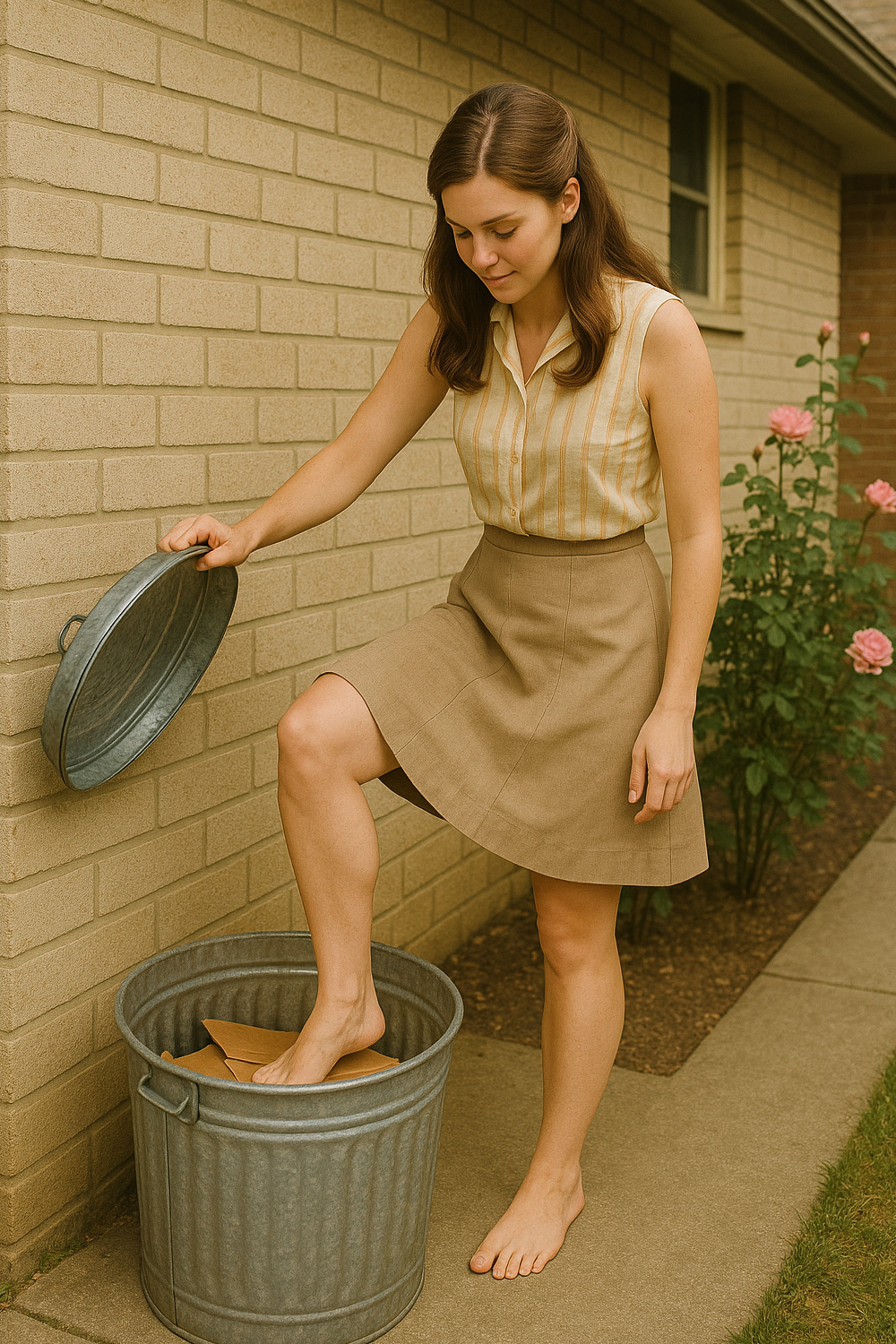
Mid-century rubbish was a chaotic mixture of everything a family discarded during the week. A single aluminium bin held food scraps, vegetable peelings, tins, glass bottles, broken utensils, packaging, paper, cardboard, garden clippings and household odds and ends. For many families, especially before the 1970s, this bin sat directly on soil or concrete next to the laundry, garage or back steps, waiting for the weekly rattle of the council truck.
These bins were modest in size and unforgiving in shape. The cylindrical walls didn't flex and the lid needed to sit properly or animals, rain or dust would enter. With only one collection each week, households quickly discovered that the key to a manageable bin wasn't the amount of rubbish they produced but how it was prepared.
Cardboard created the biggest challenge. Rigid cartons from appliances and groceries consumed enormous space despite being light. A single uncrushed carton wedged awkwardly inside the bin could compromise the entire week's rubbish. Families soon learned that volume was the true enemy. To win back space, you had to defeat the shape.
Every home evolved its own method. Some pulled apart the seams with their hands. Others tore boxes to pieces. Many dropped boxes onto the ground and crushed them with their feet, reducing it in seconds to a flat, obedient pad. The approach varied across suburbs and generations, but the principle was universal: before anything went into the bin, its shape needed to be ended.
Australians Have Always Finished Their Boxes With Their Feet

Long before recycling became a civic expectation, Australians were already ending their boxes by treading them down with their feet. A carton reached its final moment not when it entered the bin, but when it was placed on the floor and crushed until its structure surrendered. This small domestic gesture was so deeply embedded that it never needed to be taught. Children watched their parents do it. Teenagers did it with little thought. Newly married couples continued the habit in their first homes. It was simply how cardboard lived and died.
The bins themselves encouraged this behaviour. Old aluminium cans were narrow and rigid, making bulky shapes impossible to pack efficiently. A loose, three-dimensional box swallowed precious volume and trapped air pockets. A flattened one lined the curved wall neatly, creating order inside a system that otherwise had none. Whether it was a cereal box on a kitchen floor, a shoe carton on a back patio or a delivery box left on a verandah, Australians instinctively removed its volume with their feet before it reached the bin.
Inside the home, the ritual became part of everyday movement. Someone finished the cereal, dropped the empty carton to the lino and stepped on it once or twice. Someone brought a new household item and took a moment on the driveway to flatten its packaging. These were not moments of environmental care. They were expressions of household logic developed long before recycling was invented.
The habit survived through changing decades because it solved the same problem every era shared: bins had limits, and those limits had to be respected. Crushing cardboard wasn't a chore or a strategy. It was simply a way of making domestic life flow.
When Backyard Burning Was Part of Australian Life

Before regulations tightened through the 1970s and 1980s, backyard burning was as familiar as mowing the lawn. In countless suburban and rural yards, small brick incinerators or perforated metal drums stood against fences or beside sheds. These incinerators reduced the family's weekly overflow, burning through paper, packaging, timber scraps and garden debris that didn't warrant a trip to the tip.
Incinerators were found not only in backyards but also in schools, sporting clubs and community buildings. They were a routine way to deal with overflow rubbish long before kerbside systems existed, and families were used to preparing cardboard for them on the spot. Flattening boxes with the feet became the quickest way to get bulky packaging ready for the burn. Teenagers would step on the cartons to flatten them, parents added them to the drum, and the whole process felt ordinary and practical. A box collapsed cleanly under a bare foot, turning into a low, compact pad that burned quickly and safely once it went into the incinerator.
Cardboard was ideal for burning, yet even here it had to be flattened. Large uncrushed boxes burned inefficiently, unpredictably and caught the wind. Flattened cardboard, especially when crushed with feet, sat low and steady, burning cleanly without sudden shifts.
Trips to the Tip: A Weekend Chore for Many Families
Before recycling was introduced and long before councils offered bulky waste collection, families often relied on weekend trips to the local tip to clear overflow. The household bin could only hold so much, and anything too large, too heavy or too awkward for the weekly collection was set aside for a dedicated run. Every suburb had its own rough schedule. Some families went monthly, others only when the shed or laundry filled with old timber, broken toys, rusted tins, pram frames or garden prunings too bulky for the bin.
These trips were an accepted part of suburban life. Many tips were simple open grounds at the edge of town, with dirt tracks, and scattered mounds. Cars rolled in with trailers rattling, old utes heaped with scraps or station wagons with the back seats folded flat and loaded to the roof. It was noisy, dusty and oddly communal.

Cardboard was always dealt with before leaving home. Families flattened any remaining boxes so they could stack easily in the boot or trailer and so they wouldn't blow away while driving. Bulky cartons were folded and crushed until they lay flat, then slid beneath heavier items to stop them lifting in the breeze on country roads. Even at the tip, where space seemed endless, flattened cardboard was easier to handle and safer around open piles, metal scraps and uneven ground.
Even boxes that made it to the tip still met the same fate. Families often crushed any surviving cartons with their feet before tossing them onto the piles, not because space was scarce but out of respect for the shared environment. A flattened box was less likely to lift in the wind or scatter across the grounds, and it showed consideration for the workers and neighbours who used the tip as regularly as they did. Even in a place built for rubbish, Australians understood that a moment spent crushing a box kept the area tidier for everyone.
For many households these outings were an informal reset, a way to reclaim the shed, clear the yard and start fresh for another month. Children rode along, learning where waste went long before recycling centres existed. The act of flattening boxes with their feet became part of the preparation, a small but essential step in getting ready for the trip. It turned an improvised system into something manageable, predictable and distinctly Australian.
Councils Modernise Waste, but the Old Logic Remains
Through the mid to late twentieth century, Australian councils began refining their waste services. Trucks grew larger and more uniform. Collection rounds became more predictable. Bins increased in size and transitioned gradually from aluminium to sturdier materials. Households were encouraged to keep lids closed and waste contained, especially as animals, wind and urban density made spills more problematic.
Yet even with improved collection, landfill-only systems still required careful management of space. A single rigid object could force the lid open, attract animals or lead to a refused pickup. The same family logic applied: flatten it, fold it, crush it and reclaim the volume. Families continued doing what they had done for decades because the system still relied on their cooperation to work effectively.
This was still not recycling in the modern sense. It was simply domestic survival within a limited system.
The Arrival of Kerbside Recycling
By the late 1980s and early 1990s, Australian councils began rolling out kerbside recycling programs. Glass, aluminium, paper and eventually cardboard entered dedicated streams with their own collection schedules. Sorting plants depended on flat, consistent shapes that travelled smoothly across machinery. Councils issued instructions to flatten cardboard before placing it into the recycling bin to improve transport, reduce contamination and prevent the trucks from carrying unnecessary air.
What councils asked households to do was not new. Australians had been flattening cardboard for decades out of sheer necessity. Recycling formalised a domestic behaviour everyone already knew. The only difference was the purpose. What had once been about fitting the week's rubbish into a small bin now supported a broader environmental system.
Families did not have to change their behaviour. They simply placed the crushed cardboard into a different bin.
Why the Past Still Matters

Modern recycling instructions can seem rigid: flatten boxes, compact containers, avoid protruding shapes, keep lids fully closed. But these guidelines reflect the logic of earlier generations who managed waste without structured systems. Their solutions were practical, intuitive and deeply efficient, and much of today's recycling behaviour inherits that domestic wisdom.
Even now, cardboard is one of the most space-hungry items in household waste. When placed in the bin uncrushed, it fills the container prematurely, prevents the lid from closing and sends large pockets of air to processing facilities. Flattening is not just courteous. It is essential to how the system functions.
People haven't let go of the old habits either, especially when it comes to cardboard. Many still prefer to step outside and crush boxes barefoot because it feels quicker, cleaner and more controlled than wrestling with them by hand, and the simple weight of a bare foot turns bulky packaging into flat, compliant recycling with almost no effort.
A Modern System Built on Old Habits
If recycling disappeared tomorrow, Australian households would not reinvent waste management from scratch. They would naturally return to the same practices their parents and grandparents relied on. They would flatten boxes, crush shapes, bend edges inward and organise waste so the bin could serve them properly for the week. The motivations would shift away from environmental messaging and back toward simple domestic necessity, but the behaviour itself would remain the same.
Crushing cardboard did not begin as recycling. It was inherited by recycling. It emerged from generations of Australian households who discovered that the easiest way to tame a box was to drop it to the ground and finish it with their feet.
You might also like






Disclaimer: Every effort has been made to ensure the accuracy of the information provided, but we make no guarantees regarding its completeness or reliability. The data is presented for general informational purposes only and does not constitute financial, investment, or legal advice. We are not liable for any errors, omissions, or consequences arising from its use. Users should verify details with relevant sources and seek professional advice where appropriate for the most accurate and up-to-date guidance.