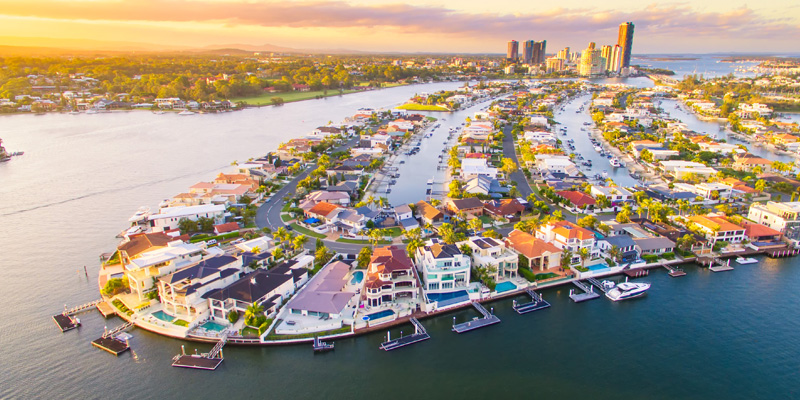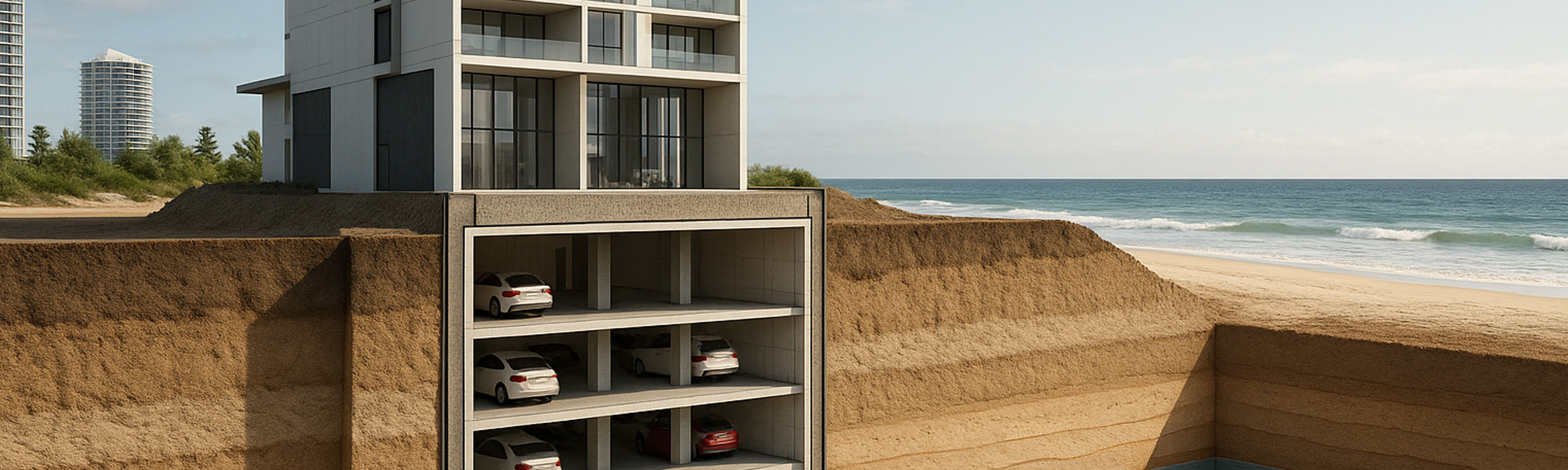
Walk along the Gold Coast beachfront and it is easy to be impressed by the skyline. Tower after tower rises effortlessly along strips of sand that only decades ago were low dunes and surf flats. What most people never stop to consider is what sits below these buildings. Many of the most recognisable towers contain three, four or even five basement levels dug deep into porous coastal sands, positioned close enough to the ocean that the water table moves under and around them daily. Intuition says these underground levels should constantly fill with seawater, or at least remain damp and unstable. Yet they remain dry, structurally reliable and surprisingly free of moisture. The explanation lies not in luck, but in a sophisticated overlap of geotechnical understanding, groundwater modelling, excavation methodology, structural engineering and active building management systems that work together in a way most residents never see.
The Coastline as a Geotechnical Environment
The Gold Coast's soil profile is entirely different from the inland geology that most people imagine when they think of basements. Instead of clay or rock, the coastal strip consists of thick layers of marine sand, aeolian (wind-blown) sand and later superficial deposits. These sands behave more like a fluid medium than a solid one in engineering terms. They drain quickly, transmit pressure uniformly and shift easily when disturbed. Water does not sit in pockets. Instead, it flows freely, driven by changes in tide, rainfall and even distant storm systems.
The water table along the coast is shallow and highly responsive. On any given day, it moves up and down through the upper soil profile in response to the tide. When king tides occur, the water table rises even further. When seasonal rains hit, it responds again. When long dry periods arrive, it retreats. This dynamic behaviour means that any excavation below the natural ground level intersects flowing groundwater almost immediately. If an excavated pit were left unsupported, water would rush into it and the surrounding sand would collapse as the pore pressure changed. Engineers must therefore design the entire excavation as a controlled operation from the first moment the sand is cut.
Why Gold Coast Towers Go Deep Underground
The depth of basement levels in modern towers is not simply an architectural preference. Planning codes require large amounts of parking for high-rise developments, and the land parcels along the coast are narrow. The only available solution is to build downwards. These basements also house essential mechanical systems including water pumps, electrical switchboards, transformer rooms, fire sprinkler tanks, sewer connections and waste management facilities. They stabilise the tower by lowering its centre of gravity and providing a large subterranean footprint that anchors the entire structure. In cyclonic regions, deeper basements add mass and stiffness, giving towers improved performance under wind loads. What appears to be a carpark is actually the base of the building's most important stability mechanism.
Constructing a Waterproof Exclusion Zone
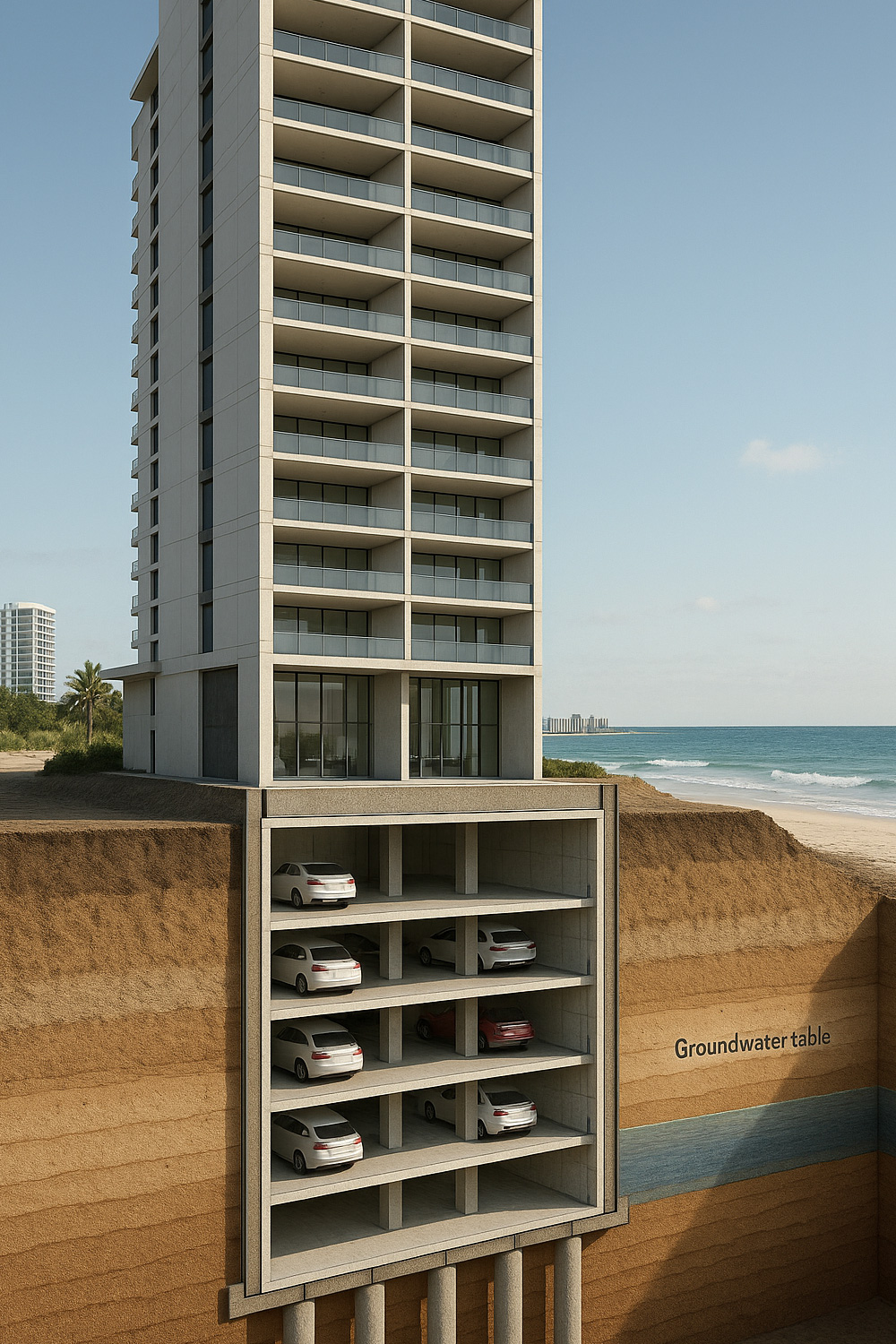
Deep basements in coastal sand succeed because they are not built to coexist with groundwater. They are built to exclude it entirely. Engineers conceptualise the basement as a giant sealed box inserted into the ground. Every surface that touches soil must resist water inflow, movement, pressure and uplift. This sealed environment requires a combination of heavy structural elements and extremely sophisticated waterproofing systems.
The process begins with the perimeter walls. Before a single bucket of sand is removed, engineers install a structural envelope around the excavation. Secant pile walls are common. These involve drilling overlapping concrete piles that interlock to form a near-continuous circular or rectangular shell. The piles are installed from the existing ground surface and cut down into deeper, denser layers of sand or even weathered rock. The overlapping geometry ensures that once all the piles are in place, the wall behaves like a solid barrier against both earth and water. Diaphragm walls are another method used in newer towers. These involve excavating narrow underground trenches that are immediately filled with reinforced concrete. The result is a monolithic panel system that forms some of the strongest retaining walls available.
Once the perimeter is established, engineers apply a waterproofing system. This is not a single membrane, but a layered approach. A typical configuration includes an initial blinding layer over the excavation floor, followed by high-density polyethylene sheets, bentonite mats and torch-applied membranes. Each material serves a purpose. HDPE provides a tough, impermeable layer. Bentonite mats swell in the presence of moisture and seal voids or imperfections. Torch-applied membranes bond tightly to concrete surfaces and prevent diffusion of moisture. At construction joints, injection grout tubes are installed so that any detected seepage can be sealed long after the building is complete. The final result is a multi-layered barrier that resists water not through a single line of defence, but through overlapping protective systems that compensate for movement, temperature change and long-term ageing.
The Phenomenon of Hydrostatic Uplift
One of the least understood challenges for coastal basements is uplift pressure. When the water table rises beneath a structure, the groundwater pushes upward on the basement slab. The pressure is similar to what acts on the underside of a boat in water. A poorly designed basement can literally try to float upward. Engineers address this by creating downward resistance using heavy slabs, foundation piles and tie-down anchors.
The base slab in a modern high-rise is not a thin plate. It is often a thick concrete raft weighing thousands of tonnes. Beneath it, deep piles penetrate the sand and anchor into firmer layers. Some designs include tension piles that work in reverse, resisting the basement's tendency to rise. When all components are in place, the basement becomes a locked structure that remains stable regardless of groundwater fluctuations.
Excavation and Dewatering
During construction, the permanent waterproofing does not yet exist, so engineers rely on dewatering systems to control the water table. This involves installing wells or spear systems around the perimeter of the site and pumping water continuously. As water is removed, the groundwater level lowers around the excavation. This temporary drawdown creates a dry or semi-dry working environment for excavation machinery and concrete placement.
Dewatering is a delicate operation. If the water table is lowered too aggressively, ground settlement can occur, affecting adjacent buildings. Engineers monitor pore pressure, settlement markers and pump output continuously. They adjust the pumping rate to avoid destabilising nearby structures. Once the basement walls and slab are complete and the waterproofing envelope is sealed, dewatering operations are shut down. The basement then becomes a permanently isolated structure.
Why Basements Remain Dry After Completion
The dry conditions inside a completed basement result from both passive and active systems. The passive systems include the retaining walls, the waterproofing layers and the heavy structural components. These elements resist water without moving. They stand against groundwater pressure and prevent moisture from entering.
The active systems handle the small amount of water that inevitably appears in any underground structure. Most basements include sump pits at their lowest points. These pits collect incidental seepage, condensation, washdown water from cleaning, and minor infiltration that occurs before membranes fully stabilise. Pumps remove this water automatically. Residents often hear pumps running at seemingly odd times, but this activity is normal. It does not indicate flooding. It reflects how underground moisture behaves. The mechanical systems ensure that any collected water is removed before it becomes noticeable.
Extreme Weather and Performance Under Stress
The Gold Coast experiences a range of conditions that test basement systems. The engineering required to obtain building approval assumes repeated cycles of these conditions over the lifespan of the structure.
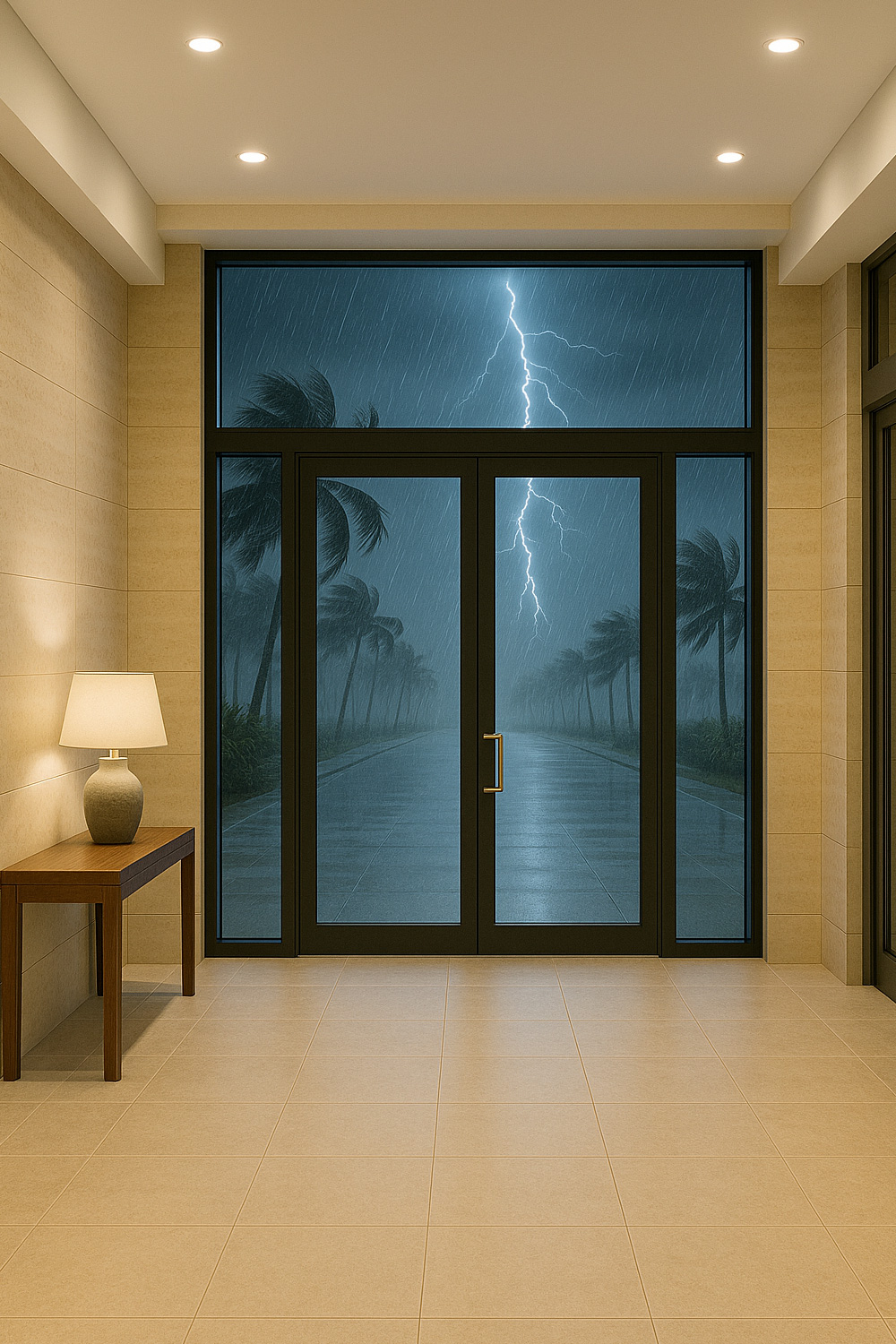
King tides raise the water table substantially. A correctly designed basement withstands this pressure without movement. The structural walls and slab are sized to resist the maximum expected uplift and lateral pressure, not the average. Heavy rain influences groundwater locally, causing small surges. Drainage systems integrated into the retaining walls relieve excess pressure. Pump systems inside the basement activate automatically to control internal moisture.
Cyclone-driven storm surge represents one of the most significant pressures on coastal foundations. Even when the ocean temporarily pushes deeper into the sand profile, the waterproofing envelope remains intact. The multiple protective layers are chosen because they do not soften, delaminate or deform under such conditions. These structures are not built for fair-weather performance. They are built for the most extreme scenario they are likely to face.
Evolution of Techniques in Gold Coast Construction
Older Gold Coast towers built in the 1970s and 1980s used simpler waterproofing methods. Many relied on bitumen-based products, plain concrete and rudimentary joint detailing. Some basements from this era perform exceptionally well, but they may exhibit higher pump activity or occasional seepage that requires attention. Advances in materials science, hydrogeological modelling and structural engineering over recent decades have dramatically improved basement performance. Today's towers benefit from better data, more precise drilling and excavation technologies, and more reliable membrane systems.
Maintenance and Long-Term Stability
A basement that remains dry is not a set-and-forget achievement. Its long-term performance relies on ongoing building management. Pumps, alarms, drainage channels and inspection points require routine servicing. Waterproofing systems remain mostly hidden, but access ports allow for periodic checking and grout injection if a minor leak appears. Successful basement operation depends on the building's mechanical systems working quietly and reliably in the background.
Residents may also notice that a healthy basement is not silent. Pumps cycle. Ventilation fans run. Stormwater control systems activate during rain events. These are signs of normal behaviour in a building that is continually managing the environmental conditions around it.
Implications for Buyers and Owners
While the engineering behind coastal basements is robust, buyers should understand a few indicators of building health. A pump that runs constantly may indicate a higher level of seepage that deserves investigation. Cracks should be interpreted carefully, as not all are structural but any cracks that show moisture movement should be examined. Persistent odours are uncommon and may indicate ventilation or waterproofing issues that require maintenance. These concerns are not routine, but they form part of informed ownership.
How This Engineering Shapes the Gold Coast
The ability to construct deep underground basements in porous coastal soils is one of the achievements that defines the Gold Coast skyline. Without this capability, towers would need wide podiums or elevated parking structures that would change the urban character of the beachfront. The elegance of modern Gold Coast architecture depends on the invisible engineering beneath it. These underground systems stabilise towers in cyclone winds, resist tidal forces, guard against groundwater and provide the essential services that allow high-rise living to function smoothly.
The Real Explanation
Basements beside the ocean do not remain dry through chance or favourable weather. They remain dry because every stage of their creation, from the initial soil testing to the final pump maintenance cycle, is part of a deliberate system engineered to resist water in all its forms. These basements behave like sealed vessels anchored into the ground, unaffected by the dynamic water table that surrounds them. They represent one of the most technically impressive but least appreciated aspects of Gold Coast construction. Every day, they protect cars, infrastructure, residents and the buildings above them from the forces of groundwater that constantly shift around them.
You might also like



Disclaimer: Every effort has been made to ensure the accuracy of the information provided, but we make no guarantees regarding its completeness or reliability. The data is presented for general informational purposes only and does not constitute financial, investment, or legal advice. We are not liable for any errors, omissions, or consequences arising from its use. Users should verify details with relevant sources and seek professional advice where appropriate for the most accurate and up-to-date guidance.