
Household recycling works best when every person quietly does their part. Some families achieve this effortlessly and their bins run like clockwork. Others live with a more familiar tension. One person goes out of their way to flatten every cardboard box under their feet. Another never does it. Someone else pushes a half-collapsed carton into the recycling bin and walks away before the lid even settles. These small mismatches in behaviour shape the whole flow of a household, turning what should be a simple task into a recurring friction point.
Encouraging proper crushing behaviour is less about issuing commands and more about understanding the quiet psychology behind domestic routines. It is about recognising why people avoid crushing, what obstacles they see that others miss, and how subtle environmental cues can change the flow of a household without a single lecture. There is a culture to recycling within families, and once you understand its currents, you can reshape it.
The Subtle Fractures in Household Recycling
Household recycling works best when everyone participates without prompting. In some homes, boxes are flattened the moment they appear. In others, they linger on benchtops and laundry floors long after the contents have been unpacked. The difference comes down to small behavioural habits that either support or undermine the system.
Crushing itself is simple. Step on the box, reduce its size and make space. Yet the psychology beneath the motion is layered. Many avoid the task because they dislike the movement or the texture under the soles of their feet. They dislike the feeling of mounting the box and riding it down as it collapses. They worry about losing balance, even for a moment. Others assume someone else will do it. These tiny inner negotiations shape the entire recycling culture of a home.
A Familiar Moment of Hesitation
Picture a quiet afternoon in a suburban driveway. A delivery has just been unpacked, and the empty box sits there, tilted slightly, waiting for someone to deal with it. A wife steps out to take a look. She nudges the cardboard with the side of her foot, studies the folds and already knows she doesn't want to crush it. She doesn't like the sudden drop when the box gives way. She doesn't like the creaking noise it might make. And above all, she doesn't like the brief, shifting sensation under her feet that comes with riding the box down as it collapses. She glances toward the house, wondering if someone else will notice the box and handle it later. She thinks about folding it instead, but the cardboard is too firm. She considers dragging it to the bin still intact, but she knows it won't fit. So she stands there, caught in a small but very real moment of hesitation that plays out in households everywhere.
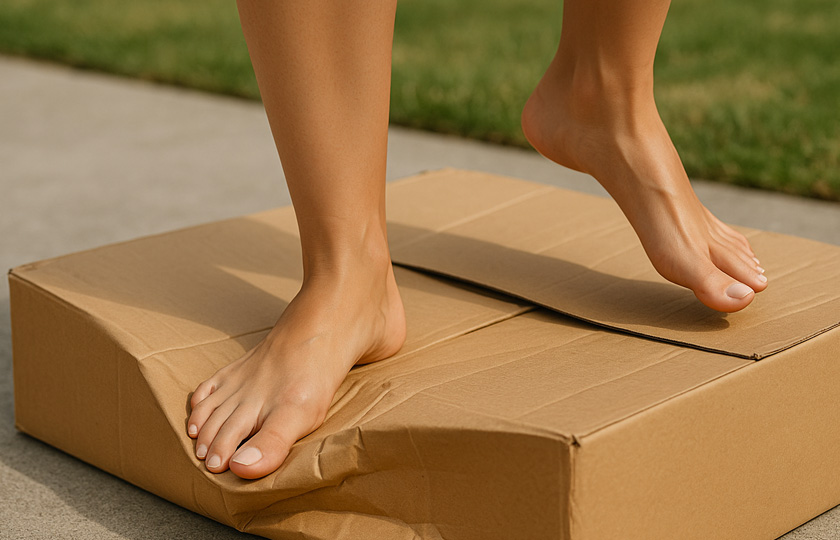
It isn't laziness or indifference. It's that the task asks a little more of you than it first appears. You have to mount the box, let the soles of your bare feet grip the surface, apply your weight and ride the cardboard down as it collapses. Then it needs a few firm treads or stamps to turn it into a neat, compact pad. It takes less than 5 seconds, but not everyone feels immediately comfortable with that small sequence, and that hesitation is often enough to make the job stall.
Why People Avoid Crushing in the First Place
Most family members who resist crushing are not avoiding responsibility for the sake of it. They usually have reasons, even if they never articulate them.
Some boxes feel awkward or intimidating. Large cartons from appliances or bulk deliveries seem too big to manage cleanly. For younger family members, cardboard can feel strangely alive. It bows, crinkles and shifts under weight, and that unpredictability creates hesitation. Others dislike touching boxes that have been stored outside or sitting in humid conditions. They worry about creepy crawlies hiding in folds. Some simply do not trust their own balance and fear feeling silly if the box moves unexpectedly.
There is also the matter of familiarity. If they did not grow up in a home where flattening was standard, crushing never embedded itself as a default step. They see it as optional rather than fundamental. Without a clear sense of why it matters, the habit never forms.
When you examine these reasons with empathy rather than frustration, the path forward becomes clearer. People adopt new behaviours when they feel safe, capable and aware of the real consequences inside the home.
Feet, Weight and Confidence

Body size and foot size play a quiet role in how people feel about crushing. Petite young women in particular, especially those with smaller feet and lighter frames, often assume they will not have enough weight to crush a box cleanly. They are worried about standing on the driveway, starting to crush and the box staying firm so they embarrass themselves in front of anyone passing by. They are worried that as they start putting their feet all over it to tackle it down, the box will still resist, refusing to fold the way they expect and making the whole moment feel awkward.
In reality, smaller soles often produce more precise and controlled results. A small foot can land directly on the weak point of a fold. A lighter frame makes the collapse smoother because the pressure is guided rather than forced. A person with a petite build often adjusts naturally, finding the centre crease and placing their sole exactly where the cardboard wants to give. Their smaller feet concentrate the pressure into a tighter point, making the collapse easier than they expect. The press feels deliberate, and the box folds neatly with a steady shift of weight.
The irony is that the features which create hesitation at the start often produce the most elegant crush. Once that first clean collapse is felt, confidence arrives quickly. The person who once avoided crushing begins doing it without a second thought.
People often underestimate how much the condition of their soles shapes their confidence on a box. Those who spend a lot of time barefoot naturally develop tougher, slightly leathery soles that feel resilient on rougher surfaces. They trust that nothing under their feet will feel uncomfortable, and the soft texture of the cardboard, along with the slight give as they press their weight onto it, often feels surprisingly pleasurable.
Softer soles, by contrast, introduce a different kind of hesitation. People who rarely go barefoot feel every ridge, every taped seam, every sudden shift in the cardboard. They're not afraid of the task itself so much as the unfamiliar sensations of doing it. Confidence grows once they learn that even soft soles adapt quickly - that the first press dulls the edges, that the second makes the surface more predictable and that by the third or fourth step the box is no longer something to navigate but something already giving way. With a few experiences like this, the difference between tough and soft soles becomes far less important, and the hesitation that once held them back fades into habit.
Being Seen Crushing the Box

Crushing a box is simple, but it changes character the moment someone feels they might be watched. Some people step onto the driveway, place a foot on the cardboard and press it down with quiet assurance. Their movement looks almost choreographed - a small sequence of placement, balance and weight that unfolds smoothly. When it goes well, the action has a kind of everyday elegance to it, the natural poise of a person guiding material into shape with their body.
Others become self-conscious precisely because of that. Crushing is unexpectedly visual. It draws attention to posture, to the shift of weight, to the way the body aligns as the cardboard gives way. They know the action can look confident - even unintentionally attractive - when performed cleanly, and that thought alone makes them cautious. People sense that the movement has a faintly presentational quality, and if the box refuses to fold on the first press or needs a few repositioned steps, they worry the smooth sequence will break and the moment will look awkward instead of controlled.
Because of this, many prefer to crush boxes where the task feels private. A side path, the garage or a shaded laundry corner lets them focus on the practical movement without wondering how it appears. When the sense of being observed disappears, the task becomes simple again.
This self-awareness isn't vanity. It is a natural response to performing a small, physical action that briefly showcases balance, coordination and the quiet elegance of the human body. Once people feel free from that momentary gaze - real or imagined - their participation becomes easier, steadier and far more natural.
Showing the Consequences in the Home
Abstract arguments about landfills rarely change everyday behaviour. People respond far more strongly to the things they see, hear and feel inside the home.
When a bin fills too fast, everyone notices. When the lid refuses to shut and the wind scatters cardboard across a yard or balcony, the irritation is shared. When a large, uncrushed box blocks a kitchen walkway or clutters a laundry floor, someone complains. These domestic outcomes are the key.
Showing the difference a proper crush makes can be as simple as turning a tall, awkward carton into a neat, low pad and placing it next to the original size. One unflattened box can consume the space of many crushed ones. When family members see this contrast, crushing stops feeling symbolic and becomes clearly practical. The home runs smoother because of it.
Natural household incentives are already built into this. The laundry stays clear because boxes do not pile up. The kitchen remains open and easy to move through. The bin lasts until collection day, and the outdoor area looks intentional rather than overrun with packaging. These are the rewards worth highlighting. When people feel tangible improvements in their daily life, they repeat the action without needing reminders.
Shoes, Half Attempts and the Box that Springs Back
A half-crushed box sitting on the driveway is almost always the result of someone pressing on it while still wearing shoes. They have stepped onto the cardboard out of habit and given it a few light pushes. The top dents, the sides bow slightly, but the moment they step off, the whole thing pops back into shape.
This happens because shoes do not give any real control. The pressure spreads across too much surface. The crease is not targeted properly, and the person cannot feel where the cardboard is ready to fold. A soft tap from a shoe does almost nothing. Instead of collapsing, the box behaves like a sprung panel and rebounds straight away. The person realises it is not working, decides it feels awkward in shoes and walks off, leaving the box half-sunken and unfinished.
When someone insists on crushing while still wearing shoes, the behaviour of the cardboard changes entirely. There is no gentle method that works. Without direct contact from the soles, the only way to break the structure is to overpower it. The cardboard has to be stomped down with committed force. The sides need kicking in firmly. Pressure must be repeated until the internal tension finally breaks. It is not elegant or precise. It is simply the only way a shoe crush succeeds.
Understanding this difference helps explain why some attempts leave boxes bouncing back and why a confident barefoot crush, or a very deliberate shoe stomp, finishes the job properly.
Turning Crushing Into a Shared Standard
In many households, one person quietly becomes the designated recycler. They collapse every box, manage every bin and deal with every collection day without discussion. The system functions, but it places an invisible weight on them, and over time that imbalance creates tension.

A true household standard forms when multiple people are seen doing the task. When boxes are left in a neutral, visible spot and different family members crush them at different moments, the job stops belonging to one person. Unspoken roles soften. The expectation shifts from "they'll do it" to "anyone can do it," and the flow of responsibility spreads naturally across the home.
Partners who don't crush boxes are rarely making a statement. Most genuinely think that placing the box near the bin is enough, believing someone more confident with the task will complete the final step. Reframing helps. Instead of pointing out what wasn't done, draw attention to what the household gains when crushing becomes shared: more space in the bin, fewer pests attracted to open packaging, a clearer laundry and fewer passive frustrations on collection day. These benefits resonate more strongly than any critique.
Confidence builds fastest through repetition in low-stakes situations. Smaller, lighter boxes inside the home or on clean concrete give hesitant family members the chance to learn how their weight, balance and soles interact with the material. They feel the first clean fold, realise they stayed perfectly steady and understand that the cardboard signals its collapse well before it happens. Once that small trust settles in, larger boxes stop feeling intimidating, and crushing becomes a natural contribution rather than a task they avoid.
The Quiet Triumph of the First Spontaneous Crush
The breakthrough moment almost always occurs without comment. A family member walks outside, sees a box lying flat, places a foot on it and presses it down. They do not announce it. They do not celebrate. They simply move on.
Yet something fundamental has shifted. Crushing has moved from being someone else's job to being part of their personal repertoire of household actions. Once that first spontaneous crush happens, it rarely remains the last. Behaviour that was once avoided becomes a small, natural contribution to the shared upkeep of the home.
The End Goal: A Calm, Self-Running System
The best recycling households are not authoritarian. They do not operate on constant reminders or policing. They function as calm, efficient ecosystems where small tasks are distributed naturally because the environment, culture and atmosphere support them.
In these homes, crushing becomes a seamless part of life. Someone steps on a box as they walk past. Someone else adds it neatly into the bin. Children mimic the movements without needing direction. The outdoor area stays clear. The bin closes properly. The laundry and kitchen remain free of awkward cardboard towers.
Cardboard does not accumulate. It flows smoothly through the domestic cycle, managed by everyone without tension or complaint. Crushing stops feeling like a chore and becomes a shared movement that keeps the entire system working the way it was meant to.
You might also like


Disclaimer: Every effort has been made to ensure the accuracy of the information provided, but we make no guarantees regarding its completeness or reliability. The data is presented for general informational purposes only and does not constitute financial, investment, or legal advice. We are not liable for any errors, omissions, or consequences arising from its use. Users should verify details with relevant sources and seek professional advice where appropriate for the most accurate and up-to-date guidance.