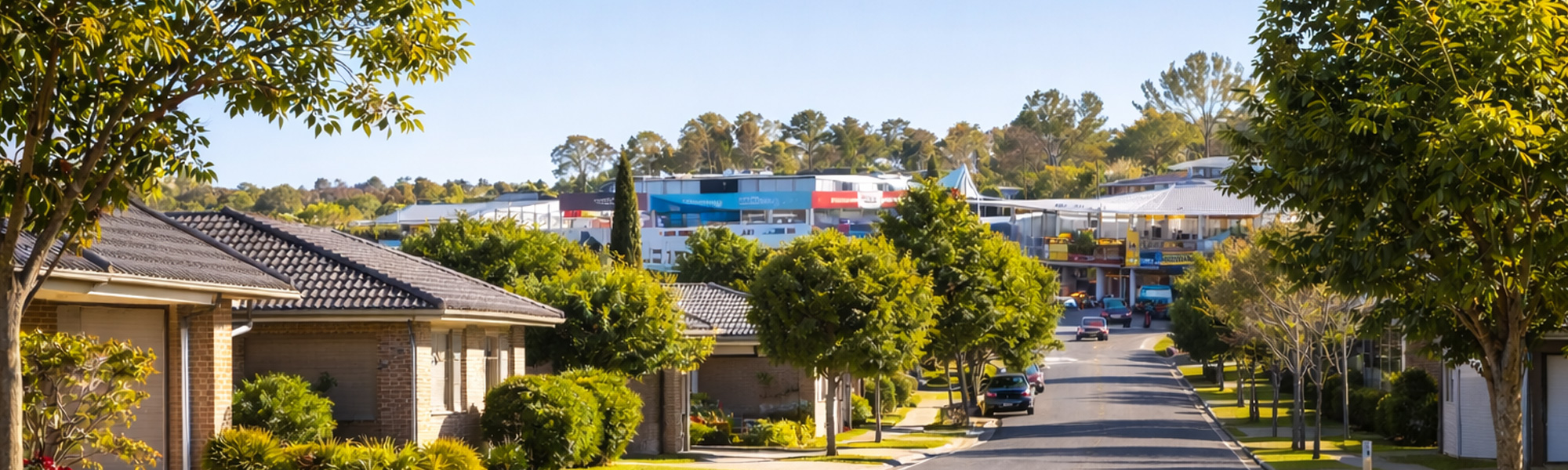
For most buyers, "close to shops" is shorthand for convenience, routine, and a certain kind of lifestyle. It reduces the effort of daily life - groceries, pharmacy runs, takeaway nights, school lunch panic, last-minute hardware. That ease translates into demand, and demand usually translates into price. But the relationship is not linear. Being three minutes away and being directly behind a loading dock are two completely different propositions. The market rewards access, but it also prices in noise, traffic, light spill, and the way a retail zone can change over time.
Why Buyers Pay More for Convenience
The strongest value uplift tends to come from properties that are close enough to make errands genuinely easy, without being so close that the centre becomes part of your daily soundscape. When someone can do a full grocery shop, grab a coffee, pick up a script, and swing past the post office without "planning the trip," they feel the benefit every week. That benefit isn't abstract - it's time saved, fewer car trips, and a simpler mental load. For households with kids, older residents, shift workers, or people juggling multiple jobs, proximity isn't a perk - it's structure.
This is why locations near well-designed neighbourhood hubs often attract consistent demand across very different buyer types. Owner occupiers like the convenience. Downsizers like the independence. Tenants like walkability and the ability to live with one car. Investors like anything that broadens the tenant pool and reduces vacancy risk.
The "Goldilocks Zone" Distance
Markets often develop a sweet spot where properties feel near shops, but not adjacent. In that zone, you get the upside of access and amenity, while avoiding the most common downsides: car park noise at night, delivery trucks early morning, weekend crowds, spillover parking on residential streets, and the constant presence of strangers walking past your boundary line.
If you're analysing value, this is the first lens to apply: are you close enough that the centre makes life easier, but far enough that the centre can't impose on your home? Buyers tend to pay for that balance because it's harder to find than people think. Lots of suburbs have a big centre. Fewer have residential pockets that sit neatly in the "near but quiet" band.
Big Shopping Centres vs Local Strip Retail
Not all retail is equal in value terms. Large centres deliver broad amenity: supermarkets, specialty stores, medical, gyms, services, and often decent public transport links. That breadth can support stronger demand, especially for households that like predictable routines and want most errands in one place. However, major centres also generate more traffic, bigger car parks, more night lighting, longer trading hours, and bigger redevelopment cycles. The upside is usually strongest when road access is easy but buffered, and when the property is not directly impacted by centre operations.
Local strip retail and small neighbourhood shops create a different kind of demand. A bakery, grocer, cafe, bottle shop, pharmacy, takeaway, hairdresser - these are lifestyle signals. They can make a suburb feel "lived in" and walkable even if it's not a high-density area. This sort of amenity tends to support steady owner-occupier demand because it shapes the vibe of weekends and evenings. The downside is that strips can be noisy if they have late-night venues, and they can change character quickly depending on tenancy mix and council decisions about outdoor dining, parking, and trading hours.
How Proximity Impacts Price
Price effects usually show up in three ways.
First is competition. If two similar homes are on the market, the one that makes daily errands easier often wins - faster sale, fewer concessions, higher emotional bidding. Second is broader buyer appeal. Properties near amenity can attract buyers who would otherwise rule out the suburb, which supports pricing even when the wider market softens. Third is rental demand. Tenants often prioritise convenience more aggressively than owner-occupiers, so proximity can lift rentability and reduce vacancy - which feeds investor competition and pushes prices.
That said, the premium is uneven and can disappear if the property is "too close" in a way that introduces constant negatives. Buyers don't pay extra to hear a refrigeration compressor, watch headlights sweep their bedroom ceiling, or fight for street parking because a centre funnels visitors into their street.
What Adds Value the Most
Certain combinations of retail amenity and neighbourhood form tend to be strongly valued:
A centre that includes a full-line supermarket plus everyday services (pharmacy, medical, bakery, post, cafes) creates the most reliable demand because it covers weekly needs. Safe, straightforward walking routes matter more than raw distance. If a property is technically close but requires crossing a hostile road, walking past blank walls, or navigating poor lighting, the lifestyle value drops.
Properties that are "near plus quiet" - where the home is insulated by topography, landscaping, road hierarchy, or building orientation - tend to capture most of the upside without paying the penalty. Buyers can feel the convenience without feeling watched or surrounded.
What Can Reduce Value
The main negatives fall into a few predictable categories, and the market is sharper about them than people expect.
Noise is the obvious one, but it isn't just traffic. It's late trading, trolley collection, delivery bays, compactors, mechanical plant, rooftop HVAC, and the rhythm of staff and customers arriving and leaving. Noise that is repetitive and time-specific can be worse than constant background noise because it interrupts sleep and becomes a daily irritation.
Traffic and access can be a deal-breaker. If the property sits on a road that becomes a queue on weekends, or if turning into the driveway is hard during peak retail periods, buyers will mentally subtract value. The same applies when school pickup routes overlap with centre access roads, creating a daily choke point.
Lighting and privacy are underrated. Car parks, signage, and security lighting can create night-time glare. Busy pedestrian routes can reduce the sense of seclusion, especially for homes with large front windows, low fencing, or outdoor living areas facing the street.
Odours and pests can matter at the micro level. Food tenancies, bins, grease traps, and waste collection zones can create smells that come and go. Even if it's occasional, buyers worry it might be frequent. That worry becomes a discount.
Perception is also real. Some buyers associate "right near the shops" with congestion, teenagers hanging around, petty crime risk, or just a constant sense of activity. Whether those fears are justified doesn't matter as much as the fact that they change what people are willing to pay.
Investor Demand vs Owner-Occupier Demand
Investors often like proximity because it broadens the tenant pool and supports stable leasing. Tenants frequently accept trade-offs that owner-occupiers won't, especially if rent is competitive. That can create a situation where a property rents well but sells with a smaller owner-occupier premium because buyers imagine living with the downsides long term.
Owner-occupiers are usually more sensitive to street feel, noise, and privacy. They'll pay up for "walkable convenience" when it feels pleasant and safe, but they'll punish anything that feels like the centre is encroaching on the home. If you're reading market signals, watch the type of buyer showing up at opens. If it's mostly investors, you may be seeing rental strength without the full owner-occupier premium.
High-Density Zoning and Future Change
One of the biggest "bad" risks - and sometimes a hidden "good" - is what proximity signals about future planning. Retail nodes often attract zoning changes over time: more apartments, more mixed-use, more traffic, more demand for parking management, more construction phases. If you buy near a major centre, you're buying near a location that councils and developers pay attention to.
That can be good if the suburb is improving in a way that boosts amenity, transport, and perceived desirability. It can be bad if your quiet street becomes a rat run, or if a low-rise outlook becomes a blank wall. Markets price this differently depending on the buyer. Some buyers will pay for "future-proof amenity." Others will discount heavily for uncertainty.
Walkability Is Not Just Distance
Two properties the same distance from a centre can perform very differently if one feels walkable and the other doesn't. The presence of footpaths, shade, safe crossings, street lighting, and a pleasant route matters. So does the nature of what you walk past. If the route is along a loud arterial road with no buffer, buyers mentally downgrade the benefit. If it's through a quiet pocket with trees and passive surveillance, buyers upgrade it.
This is why a simple radius map can mislead. Demand follows perceived ease and safety, not just metres.
Street-Level Factors Buyers Actually Notice
If you want a practical checklist for how proximity will play in the market, focus on what buyers experience in the first five minutes:
- Can they get in and out of the street easily at peak times, or does it feel like a permanent traffic puzzle?
- Do they hear the centre from the front yard, or does it feel distant?
- Is there overflow parking in the street on weekends?
- Do they feel watched by passing pedestrians or drivers?
- Does the home have outdoor areas that face away from the activity, or does the backyard back onto car parks and service lanes?
- Are there visible buffers like landscaping, fences, elevation changes, or simply another block of homes between the property and the retail edge?
These cues shape the emotional read, and the emotional read drives offers.
When "Close to Shops" Backfires in Listings
Agents love the phrase, but buyers have learnt to translate it. If a listing leans too hard on "close to shops," some buyers assume there's a reason the house needs that crutch - busy road, compromised privacy, awkward access. The most valuable kind of proximity is the kind that doesn't need to be shouted. Buyers discover it, feel it, and then justify a higher number because it solves problems in their head.
How to Use This in a Market Article
If you're writing this as a market explainer, the useful takeaway is simple: proximity to shops increases demand when it improves daily life without importing the centre's operational impacts into the home. Pricing lifts are strongest in that balanced zone, and weakest - sometimes negative - when the property is exposed to noise, traffic, light, service areas, and future redevelopment uncertainty.
You might also like






Disclaimer: Every effort has been made to ensure the accuracy of the information provided, but we make no guarantees regarding its completeness or reliability. The data is presented for general informational purposes only and does not constitute financial, investment, or legal advice. We are not liable for any errors, omissions, or consequences arising from its use. Users should verify details with relevant sources and seek professional advice where appropriate for the most accurate and up-to-date guidance.