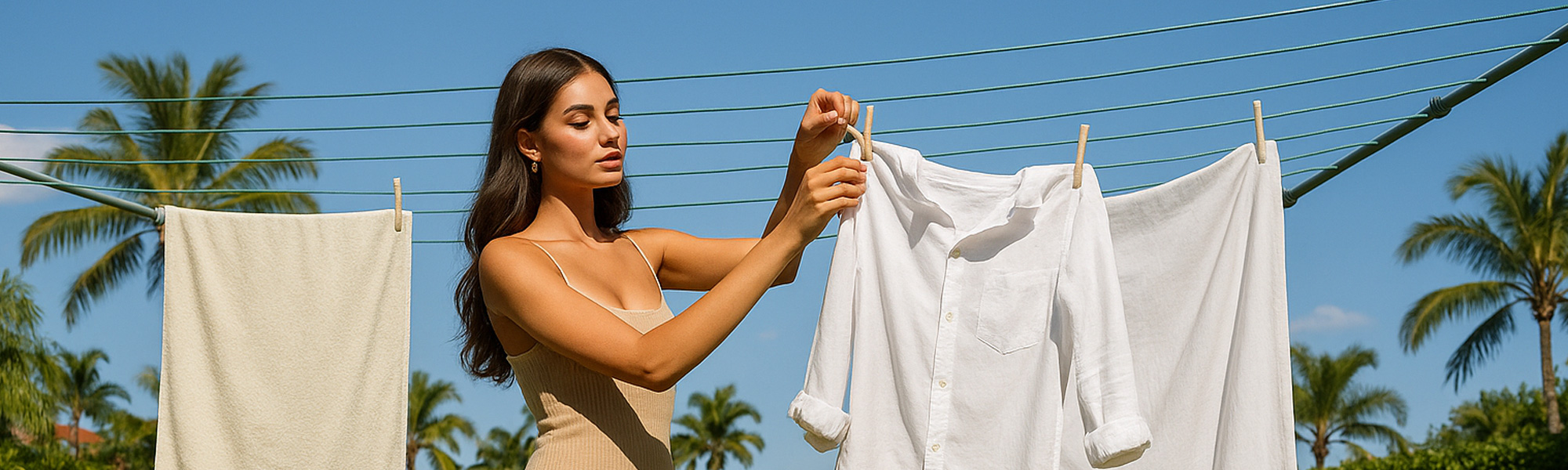
For many people moving to the Gold Coast, especially those from places like the UK, Europe or North America where colder climates, long winters and indoor-dryer culture dominate, the normality and efficiency of hanging laundry outside here can feel unexpectedly refreshing. Clotheslines aren't an afterthought here. They're an essential part of daily life, woven into patios, side paths, courtyards and balconies. Even prestige homes with high-capacity dryers still rely on sunlight and coastal air as the primary way to finish a wash.
The behaviour isn't nostalgic or old-fashioned. It's practical, efficient and perfectly tuned to the way Gold Coast households actually live. Step into any backyard at midday and you'll see the same thing: sheets moving gently in the sea breeze, activewear pegged neatly in rows and the unmistakable look of laundry that dries in record time.
The Climate Makes It Almost Effortless
people a huge advantage thanks to warm temperatures, moderate humidity patterns and dependable sunlight. Even in winter, the daytime warmth supports quick evaporation. A load of washing hung by late morning is usually dry by early afternoon with no mechanical assistance.
Homes across the region take full advantage of these conditions. Builders and renovators often orient outdoor spaces to catch breezes, and many properties feature open lawns, side areas or screened courtyards that act as natural drying rooms. The result is a climate that rewards the simplest possible method.
It Saves Money Without Feeling Like a Compromise
Energy bills across Australia continue to climb, so households pay closer attention to how often they run dryers. On the Gold Coast, the decision barely feels like a sacrifice. Sunlight is free, fast and harsh enough to evaporate water long before a dryer would finish its cycle. Families who hang their laundry outside notice the difference quickly. Bills come down, clothes last longer and drying stops being a noisy, power-intensive task.
Even people in high-end homes with premium appliances still prefer to use the dryer only when weather conditions force the issue. The local mindset is simple: if the conditions outside can do the job, let them.
Clothes Actually Last Longer Here
One of the lesser-known reasons why outdoor drying is so embedded in Gold Coast culture is its effect on fabric longevity. Heat-pump dryers and condenser dryers are gentler than older machines, but they still apply consistent heat and motion. Sun drying removes the friction component entirely.
Soft furnishings, school uniforms, swimwear, delicates, cotton basics and linen all benefit. Colours stay brighter and fibres maintain their structure. Locals often comment on how much newer clothes look when most of their drying time is spent outside rather than inside a drum.
This isn't a niche lifestyle detail. It's part of how Gold Coast households protect the value of their clothing, especially in active or family-oriented homes where washing machines run daily.
It Fits the Outdoor Lifestyle
Gold Coast homes are built around moving easily between inside and outside. Laundry habits follow the same flow. A person steps out onto the lawn or deck with a basket, barefoot, enjoying the warmth of the paving or grass, and works through the pegs without thinking twice. The clothesline becomes another part of the outdoor environment, not a chore station tucked away.
People often hang laundry as part of their morning check-ins around the home. Watering pots, opening doors for ventilation, resetting outdoor furniture, sweeping a deck and hanging a load all merge into a single fluid, outdoor routine. Drying clothes in fresh air simply aligns with how people already live here: relaxed, open-air, and connected to the weather.
It's Faster Than Any Machine Most Days
Visitors often underestimate just how quickly laundry dries in Gold Coast conditions. The combination of intense sunlight and the inland-coastal airflow shortens drying time dramatically. Items that would take an hour in a dryer often take 20 to 30 minutes on a clothesline, depending on the day's weather.
This reliability means locals plan around it. Morning wash cycles become part of the rhythm of the home. People know they can clear a laundry basket early and have everything folded and put away by mid-afternoon. Even households with multiple children find that two or three consecutive loads dry easily before dinner.
It Supports a Quieter, Cleaner Home
Dryers introduce noise, heat and humidity into a property. Outdoor drying removes all of that. Homes stay cooler, laundry rooms avoid moisture build-up and living areas feel calmer. Many households actively avoid running a dryer during summer because it adds unnecessary warmth to already-warm rooms.
Outdoor drying also reduces lint and fabric shedding indoors, which helps with general cleanliness. Over a long period, the whole house benefits from fewer airborne fibres and less appliance-generated heat.
It's Social and Surprisingly Enjoyable
On the Gold Coast, hanging out laundry isn't a hidden task. It's normal to see neighbours outside doing the same thing at similar times, often exchanging a quick hello. The task encourages people to step into their yard, breathe the coastal air and take a short grounding moment in their day.
This isn't something people often say out loud, but they feel it. Many find the process calming. There's a simple physical rhythm to pegging each item, spacing them out, and watching the breeze lift the fabric. It's the opposite of the enclosed, mechanical feel of a laundry room. It becomes an outdoor break rather than a household obligation.
The Habit Becomes Second Nature
Once people get used to outdoor drying on the Gold Coast, they rarely go back. The advantages pile up so quickly that the behaviour becomes reflexive. It's environmentally sensible, cost-saving, fabric-friendly and woven effortlessly into the style of life people already lead.
The image of laundry moving quietly in a coastal breeze isn't just decorative. It's a sign of a home that works with its environment. That's why everyone hangs out their laundry here: it makes life easier, better and more connected to the place they live.
You might also like





Disclaimer: Every effort has been made to ensure the accuracy of the information provided, but we make no guarantees regarding its completeness or reliability. The data is presented for general informational purposes only and does not constitute financial, investment, or legal advice. We are not liable for any errors, omissions, or consequences arising from its use. Users should verify details with relevant sources and seek professional advice where appropriate for the most accurate and up-to-date guidance.