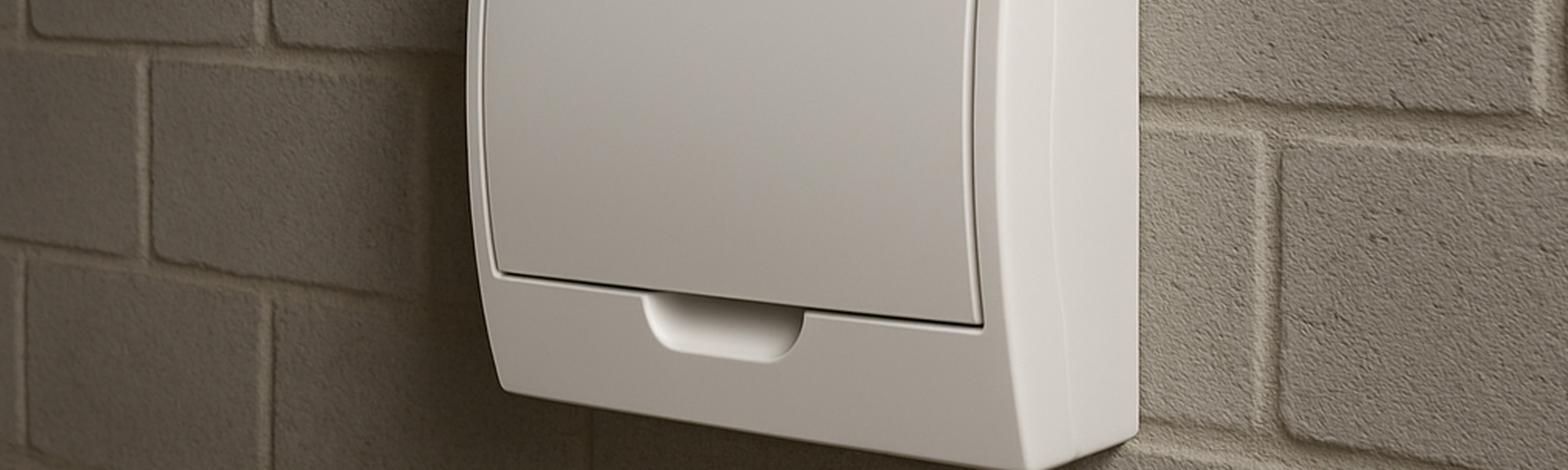
In many Queensland homes, electrical protection is split between two places. The electricity meter and main service protection sit in an external meter box, often on a boundary fence or front wall, while some or all of the circuit breakers may be located inside the dwelling or garage. Where those breakers are placed has real consequences for safety, maintenance, weather exposure, compliance and day to day usability.
Installing circuit breakers in a garage rather than leaving them outside in the meter box is not just a convenience decision. It affects how reliably the system performs over decades, how easily faults can be diagnosed, how safely circuits can be isolated, and how well the installation aligns with modern Queensland electrical standards and best practice.
Typical Queensland Meter Box Layouts and Their Limitations
Queensland housing stock includes a large number of external meter boxes mounted on front facades, fence lines or shared utility pillars. Historically, these boxes contained rewireable fuses or early circuit breakers and were considered acceptable locations for both metering and protection.
While modern meter boxes are weather rated, they are still exposed environments. Heat, humidity, salt air in coastal areas, insects, dust and vibration all take a toll. Even when a box is technically compliant, long term reliability can suffer, especially in subtropical and coastal conditions common across South East Queensland.
External placement also creates practical issues. Resetting a tripped circuit during rain, at night, or during a power event can be awkward and unsafe. For families, tenants or elderly occupants, accessing an outdoor box may not be straightforward.
What Queensland Wiring Rules Actually Require
Electrical work in Queensland must comply with AS NZS 3000, commonly known as the Wiring Rules, as well as additional Queensland specific requirements enforced by the Electrical Safety Office.
The rules do not prohibit circuit breakers from being installed outdoors, but they do impose strict conditions. Equipment must be suitably rated for the environment, protected against moisture ingress, mechanical damage and UV exposure, and must remain readily accessible. Readily accessible does not simply mean reachable. It means safe, unobstructed access without special tools, ladders or unsafe conditions.
As installations become more complex, with RCD protection, multiple subcircuits, solar, batteries and EV chargers, meeting these requirements in an external box becomes harder. This is one of the reasons modern builds increasingly relocate circuit protection into garages or internal switchboards.
Environmental Stress and Electrical Longevity
Circuit breakers are mechanical devices with moving components and calibrated trip mechanisms. Heat cycles, humidity and corrosion directly affect their accuracy and lifespan.
A garage environment, while not fully conditioned, is vastly more stable than an outdoor wall or fence mounted box. Temperature swings are reduced. Moisture exposure is lower. Insects and vermin are easier to control. Dust levels are generally lower than roadside or garden facing enclosures.
Over time, breakers installed in garages are less likely to nuisance trip, less likely to seize, and more likely to operate within their designed tolerances when a fault actually occurs. This directly improves electrical safety.
RCD Performance and Safety Implications
Modern Queensland standards require residual current devices on most circuits. RCDs are sensitive devices designed to trip quickly when they detect leakage current. Their reliability depends heavily on clean internal contacts and stable operating conditions.
External environments increase the risk of moisture related leakage paths and contamination. While RCDs are designed to tolerate some exposure, long term reliability is significantly better indoors or in a sheltered garage board.
When RCDs fail prematurely, they often do so in ways that are hard for homeowners to diagnose. Relocating them to a garage board improves reliability and makes testing and replacement simpler.
Ease of Fault Finding and Maintenance
When a circuit trips, time matters. Refrigerators, freezers, medical equipment, internet infrastructure and security systems all depend on quick restoration.
A garage mounted switchboard allows immediate access. Lighting is usually available. Labels are readable. Tools and phones are nearby. Resetting or isolating a circuit can be done calmly and safely.
Electricians also benefit. Fault finding is faster when circuits are clearly laid out in a clean, dry environment. This reduces labour time, lowers call out costs, and improves diagnostic accuracy.
Safety During Storms and Emergency Conditions
Queensland storms bring wind driven rain, lightning and power fluctuations. It is not uncommon for circuits to trip during severe weather events.
Accessing an outdoor meter box during a storm increases risk. Wet ground, metal enclosures and reduced visibility are not ideal conditions for interacting with electrical equipment. Even if the box itself is compliant, the surrounding environment may not be safe.
A garage board allows isolation and reset without exposure to weather. In emergency situations, including electrical faults, fires or flooding, having control inside the building envelope improves response options.
Improved Security and Tamper Resistance
External meter boxes are accessible to anyone who can reach them. While energy meters are sealed, circuit breakers can still be interfered with in some configurations.
Garage mounted boards reduce the risk of tampering, accidental interference or deliberate misuse. This is particularly relevant for rental properties, multi occupant households, or homes with shared access points.
For properties with short term accommodation or high visitor turnover, internalising electrical protection adds an extra layer of control.
Integration With Modern Electrical Systems
Homes are no longer electrically simple. Solar inverters, battery systems, EV chargers, home offices, air conditioning and pool equipment all add complexity.
Garage switchboards provide space. Space for additional breakers, surge protection devices, energy monitoring equipment and compliant separation between systems. External meter boxes are often physically limited and were never designed to handle modern loads.
Future upgrades are easier when the main board is inside the garage. This reduces the need for external modifications, additional enclosures or awkward retrofits.
Compliance and Upgrade Path for Existing Homes
For older Queensland homes, relocating circuit breakers to the garage is often done during major electrical upgrades. This may include rewiring, solar installation, switchboard replacement or compliance upgrades.
While relocation requires licensed electrical work and coordination with the energy distributor, it is generally straightforward. The meter remains outside as required by supply authorities, while a submain feeds the internal or garage board.
This approach aligns with current best practice and simplifies future compliance as standards continue to evolve.
Practical Design Considerations in Garages
Not all garages are equal. Switchboards should be mounted clear of vehicles, impact zones and stored materials. Adequate clearance, lighting and signage are still required.
Height, access and working space must comply with the Wiring Rules. Ventilation is important, but direct exposure to weather should be avoided. A well designed garage installation balances protection with accessibility.
When External Boards Still Make Sense
There are situations where external boards remain appropriate. Rural properties, pole mounted supplies and certain strata arrangements may require external protection.
In these cases, using high quality enclosures, corrosion resistant components and regular inspection becomes critical. The decision is not purely about location, but about environmental control and long term reliability.
Why the Trend Is Moving Indoors
Across Queensland, the trend toward garage and internal switchboards reflects experience, not theory. Electricians, inspectors and homeowners have seen the difference over time.
Reduced faults. Easier maintenance. Better safety during storms. Improved compatibility with modern electrical systems. All of these benefits accumulate quietly over the life of the home.
Installing circuit breakers in the garage instead of leaving them outside in the meter box is a practical upgrade that aligns with how homes are actually used today. It respects Queensland conditions, modern electrical demands and the reality that safety and reliability matter most when something goes wrong.
This article is provided for general information only and does not constitute electrical advice. Electrical meter boxes and switchboards contain live components that pose serious safety risks if handled incorrectly, and requirements vary by property and change over time. Any inspection, modification, repair, or upgrade should only be carried out by a licensed electrician and, where required, in coordination with the relevant electricity distributor or authority.
You might also like






Disclaimer: Every effort has been made to ensure the accuracy of the information provided, but we make no guarantees regarding its completeness or reliability. The data is presented for general informational purposes only and does not constitute financial, investment, or legal advice. We are not liable for any errors, omissions, or consequences arising from its use. Users should verify details with relevant sources and seek professional advice where appropriate for the most accurate and up-to-date guidance.