Australia's move toward more accessible housing is both necessary and overdue. An ageing population, longer periods of independent living, and the rising cost of retrofits all support the case for building homes that can adapt over time. Most people working in residential construction support that direction.
What is becoming increasingly visible, however, is a quieter problem inside the system itself. In some projects, especially medium-density developments, accessibility compliance is producing outcomes that are technically correct but functionally worse than the designs they replace. This is not a philosophical objection to accessibility. It is a practical concern about how rules are interpreted, measured, and enforced on real sites.
The Gap Between Intent and Enforcement
Most accessibility provisions in housing are grounded in sound intent. Step-free access, wider circulation, and usable ground-floor amenities are meant to improve day-to-day living and long-term flexibility. These ideas are strongly aligned with the Livable Housing Design Guidelines and, more recently, with the National Construction Code.
The problem emerges at the point of enforcement. Compliance is assessed almost entirely through fixed dimensions and measurable clearances. Certifiers are required to verify that minimum spaces are met exactly as drawn. Once a measurement fails, even by a small margin, the design is treated as non-compliant regardless of how usable the space may be in practice.
This creates a system where centimetres matter more than outcomes.
Livable Housing Design Guidelines as the Foundation (LHDG)
Much of Australia’s current residential accessibility framework draws heavily on the Livable Housing Design Guidelines (LHDG), originally developed by Livable Housing Australia (LHA), which has since ceased operations. These guidelines were developed to encourage homes that can be lived in comfortably across different life stages, without turning domestic spaces into institutional environments.
At their core, the guidelines are outcome-focused. They prioritise step-free entry, usable circulation, and bathrooms that can be adapted over time. For many years, they operated as a voluntary framework, shaping good design rather than dictating exact layouts.
The shift occurred when elements of the guidelines were absorbed into the National Construction Code. Once that happened, principles intended to guide design became minimum thresholds that must be met precisely. This is where the tension between intent and enforcement begins.
When Small Breaches Trigger Large Consequences
A common failure point involves minor encroachments into circulation space. A hand basin projecting slightly further than anticipated. A door leaf swing that overlaps a clearance zone by a narrow amount. A nib wall that grows during detailing.
In isolation, these issues are trivial. In the compliance framework, they are fatal.
Once a space fails a minimum clearance, the entire room can be rejected. The original intent of the design no longer carries weight. There is no formal mechanism to argue functional equivalence or practical usability. The only available response is redesign.
What makes these breaches so destructive is not their scale, but their irreversibility. Once a layout tips over a numerical threshold, there is no graduated response. A two-centimetre overrun is treated the same as a complete obstruction. Designers, certifiers, and planners are all pushed into a binary decision space where pass or fail replaces judgment. The result is a compliance cascade, where a minor dimensional issue forces wholesale reconfiguration, often consuming circulation space elsewhere and degrading the very accessibility outcomes the rules were meant to protect.
That redesign often leads to worse real-world access.
How Garages Became Accessibility Workarounds
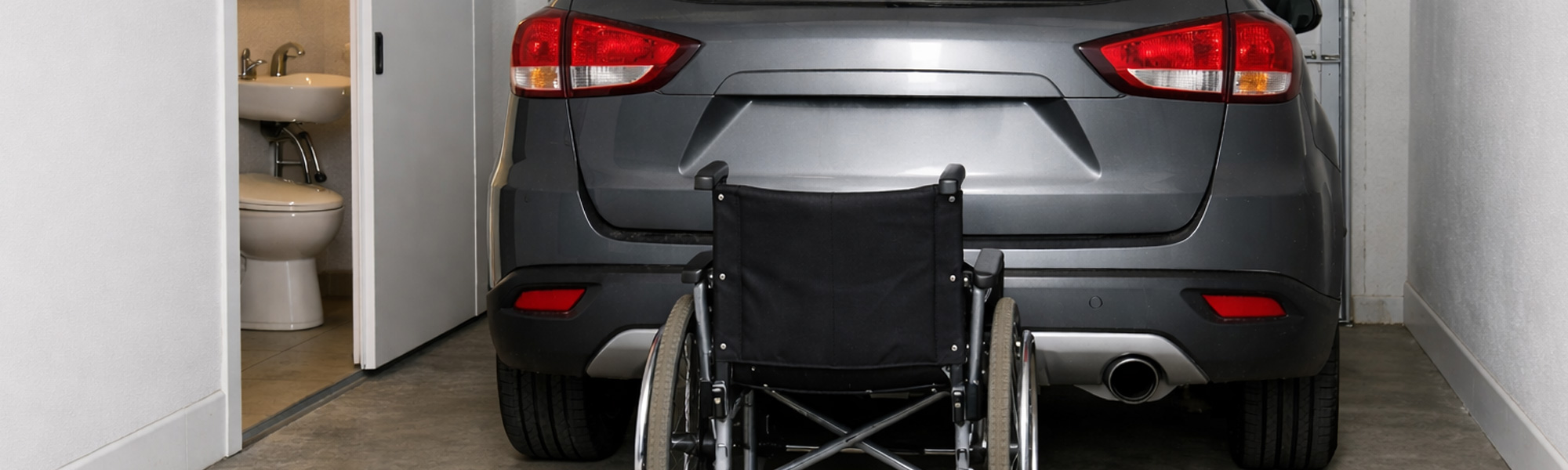
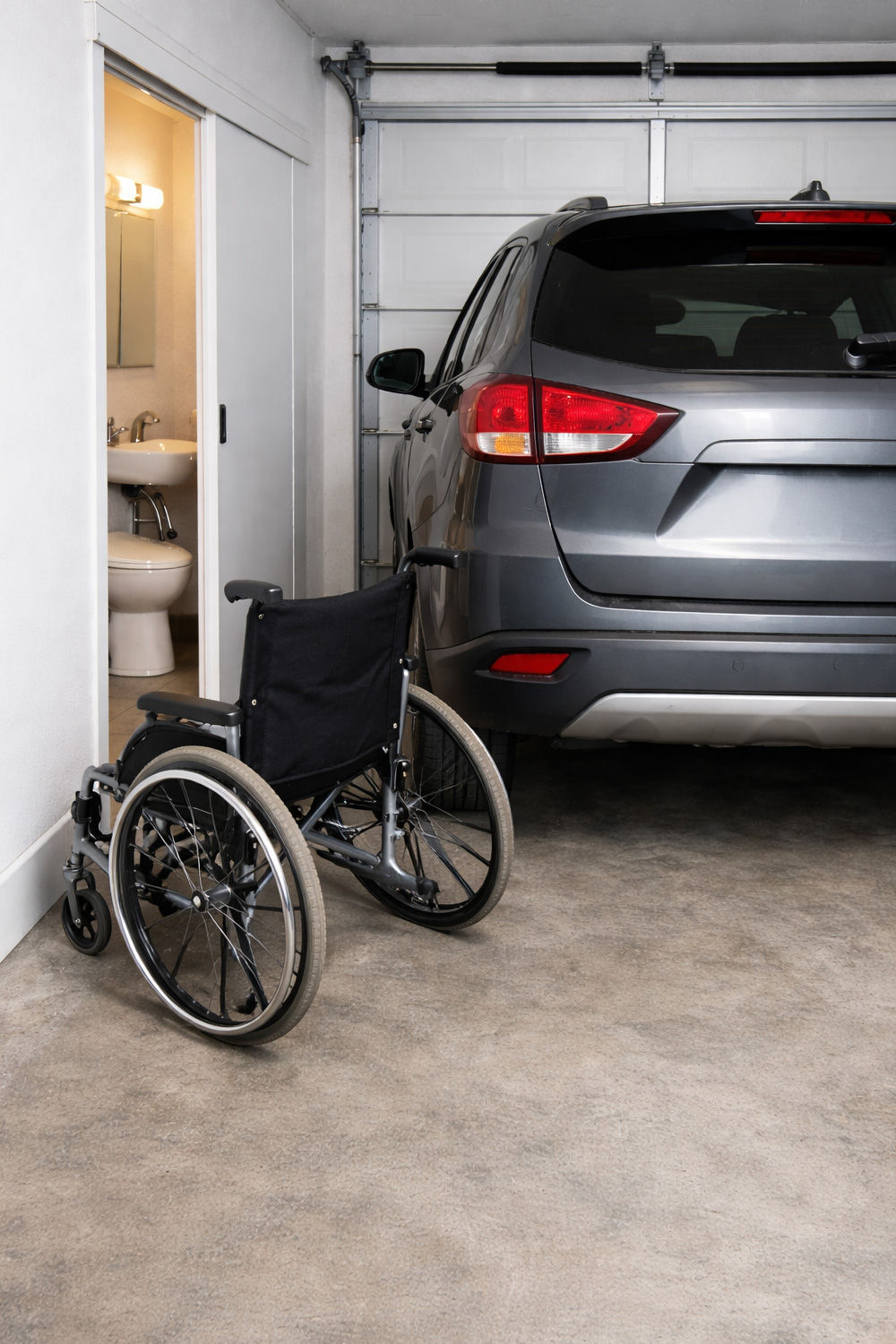
One of the most common responses to failed ground-floor toilet compliance is relocation. When internal layouts can no longer be adjusted without major cost, accessible toilets are frequently moved into garages or ancillary spaces.
On paper, this works. The required clearances can be drawn cleanly. The NCC requirement is technically satisfied. Certification can proceed.
In practice, these spaces are often compromised the moment a car is parked. Clearances disappear. Access paths narrow. Weather exposure increases. Manoeuvring becomes harder, not easier.
Yet from a compliance perspective, none of that exists. The drawings meet the rule. The outcome is certified.
Why Certifiers Cannot Exercise Discretion
It is easy to assume this problem is caused by pedantry or lack of judgement. In reality, it is driven by liability.
Certifiers operate under strict audit frameworks. Their decisions are assessed years later against measurable criteria. They cannot approve based on intent, common sense, or lived experience. If a dimension is short, approval exposes them to professional risk.
As a result, the system encourages conservative interpretation and discourages nuance. Certifiers do not have discretion to weigh one accessible outcome against another. They can only confirm compliance or refuse it.
Standards Designed For Other Building Types
Another underlying issue is that many accessibility standards were originally written for public and commercial buildings. The AS 1428 suite, in particular, was never intended to be applied wholesale to detached houses or compact townhouses.
When these standards are partially translated into residential construction, awkward consequences follow. Domestic layouts are smaller. Circulation paths are tighter. Garages, corridors, and stair zones behave differently to institutional buildings.
Applying rigid public-building measurements to domestic environments without a hierarchy of intent leads to distortions that satisfy the rule but undermine the lived experience.
Industry Criticism Is Widespread But Muted
These concerns are not fringe views. Architects, access consultants, builders, and developers regularly raise them in private conversations. The frustration is not with accessibility as a goal, but with a system that sometimes produces counterproductive outcomes.
The difficulty is that public criticism is easily misread. Questioning how rules operate can be framed as opposing accessibility itself. As a result, many professionals comply quietly, redesign reluctantly, and move on.
The outcome is a growing number of homes that are compliant on paper but awkward in daily use.
Accessibility Measured Versus Accessibility Experienced
The core tension is simple. Accessibility is being measured, not experienced.
Clearances are checked with rulers, not wheelchairs. Drawings are assessed, not homes. Compliance is binary, even though usability is not.
This does not mean the solution is to abandon standards. It means the system needs a better way to reconcile intent with enforcement, particularly where small technical breaches produce materially worse outcomes.
Toward Better Alignment, Not Less Accessibility
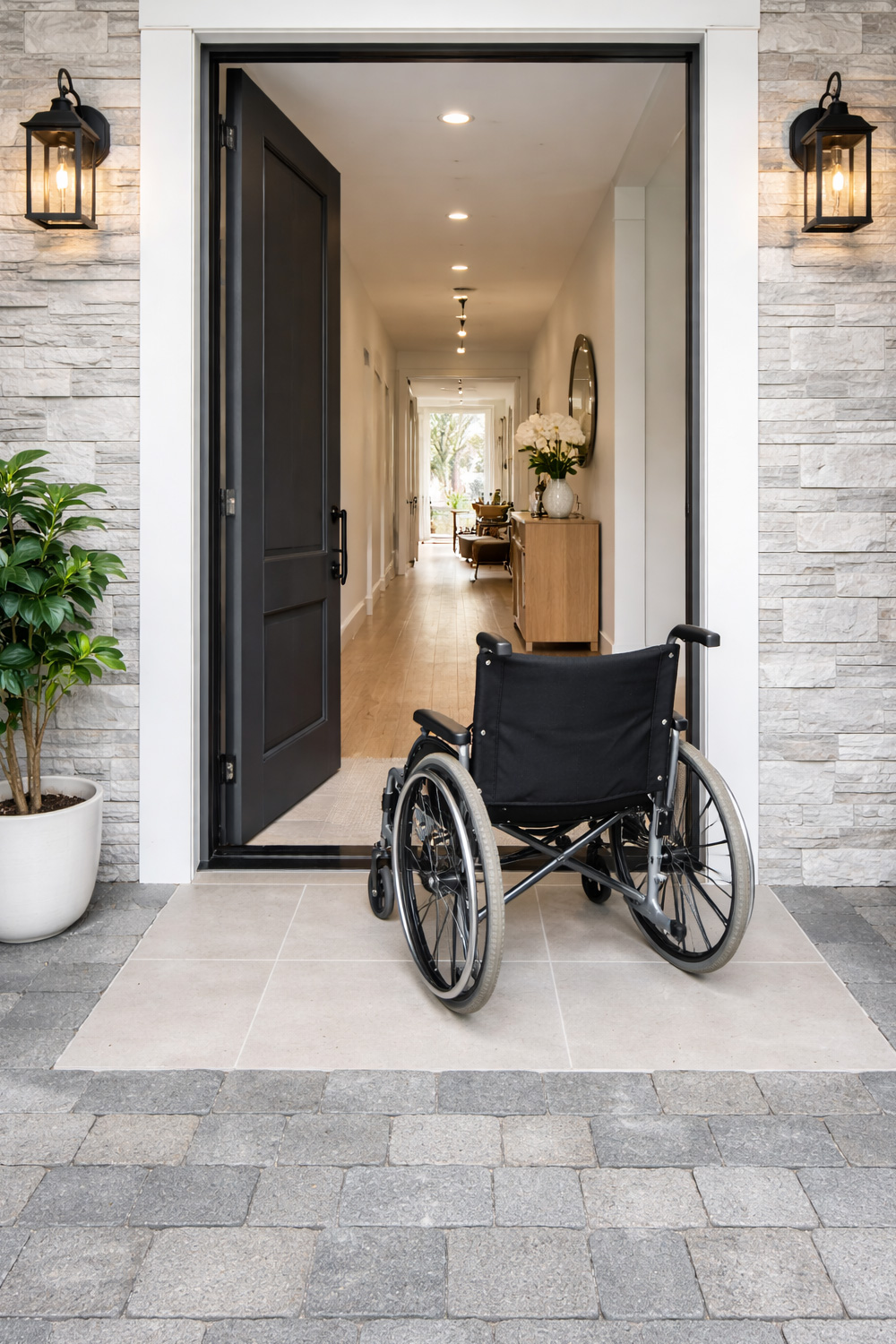
There is room to improve without weakening the goal. Allowing limited discretion for functional equivalence. Recognising trade-offs between competing access outcomes. Providing clearer residential-specific guidance. These are policy questions, not ideological ones.
Accessible housing works best when it is integrated naturally into the design, not forced into corners to satisfy a measurement. The industry broadly agrees on that. What it lacks is a framework that allows common-sense outcomes to be certified safely.
Until that gap is addressed, stories of compliant but unusable spaces will continue to circulate quietly through the market, even as the stated goal of accessibility remains widely supported.
What is missing is not commitment, but calibration. Residential buildings are not hospitals, and homes succeed or fail on how spaces are actually used over time, not how they diagram on a plan. A framework that can recognise intent, accommodate minor variation, and still protect minimum outcomes would strengthen accessibility rather than dilute it. Until regulation reconnects with lived use, compliance will continue to drift away from practicality, and accessibility will be judged by measurements met rather than spaces that genuinely work.
You might also like






Disclaimer: Every effort has been made to ensure the accuracy of the information provided, but we make no guarantees regarding its completeness or reliability. The data is presented for general informational purposes only and does not constitute financial, investment, or legal advice. We are not liable for any errors, omissions, or consequences arising from its use. Users should verify details with relevant sources and seek professional advice where appropriate for the most accurate and up-to-date guidance.