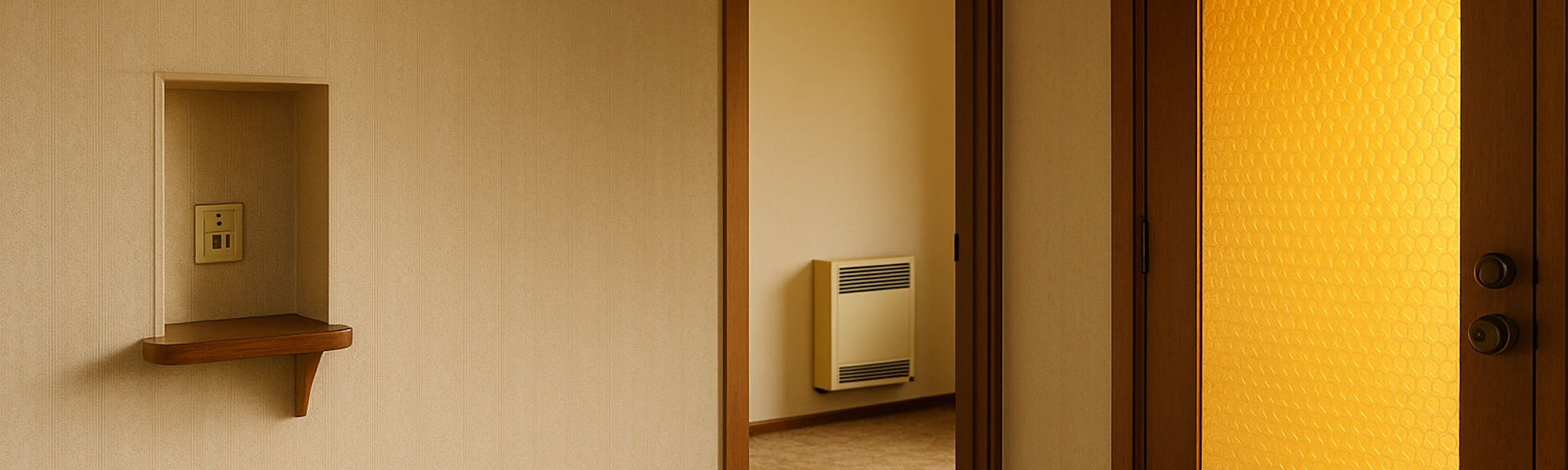
Older homes are full of secrets. Not dramatic, cinematic ones, but the quiet, fascinating traces left by generations who improvised, adapted and built according to the anxieties, fashions and technologies of their era. Renovations tend to smooth the edges, but older suburbs still hide thousands of houses whose bones carry personal and cultural stories far stranger than a loose phone port or a dated light switch.
If you know what to look for, these relics turn an ordinary inspection into something closer to archaeology.
Exploring old parts of a house can be unsafe. These areas may be unstable or contain asbestos, chemicals, dusts or old wiring that do not meet modern standards.
Always have concealed or deteriorated spaces checked by a licensed professional before entering, disturbing materials or opening any old containers.
Hidden Bunkers, Store Rooms and "Cyclone Rooms"
While Australia didn't experience the same Cold War bunker boom as the US, some households - especially from the late fifties into the seventies - built reinforced rooms under garages, trapdoor-accessed pits beneath laundry slabs or strangely thick-walled storerooms designed as improvised survival spaces. In cyclone-prone northern regions, some families created internal concrete "safe rooms," doubling as storage nooks during calmer seasons.
A surprising number of these exist quietly beneath houses, half-forgotten because the door swelled shut decades ago or the steps rotted away. When rediscovered, they often contain relics of the period: fuel tins, pre-digital torches, preserved water jugs, maps, newspapers, military surplus blankets and rusted hand tools.
Fallout Shelters Built by DIY Enthusiasts
A rare but very real subset of mid-century homes contains backyard fallout shelters inspired by international Cold War manuals. Some were nothing more than reinforced pits once covered by steel plates and soil. Others became half-underground rooms lined with brick or blockwork, accessed by a sunken stairway now overgrown by bougainvillea.
Inside, you may find long-expired canned goods, crude ventilation pipes, shelves for supplies, and sometimes hand-painted signage. They're snapshots of an era when global politics filtered into suburban imagination.
Underground Fuel Storage and Car-Service Pits
Before workplace regulations tightened, many households stored kerosene, diesel or generator fuel in underground tanks or drums. A few older properties still have them buried beneath yards or beside sheds. Even more common is the domestic mechanic's pit: a sunken trench in the garage where the home handyman once lay beneath the car to service it. These pits sometimes include lighting recesses, tool shelves and improvised railings to climb in and out. Some remain untouched, now ghostly dark cavities under metal grates.
Odd Architectural Additions: Panic Buttons, Safe Deposit Slots, Money Hatches
Some older homes contain small sliding metal doors built into walls that once allowed milk or bread deliveries. Others have "money hatches" used by home-based businesses to exchange cash securely. A small number have early panic buttons installed near beds or pantries, feeding into primitive buzzers that alerted the main hallway.
These were domestic answers to very specific anxieties - burglary, conducting business from home, storing valuables - and their surviving hardware gives a sense of households negotiating safety long before digital solutions existed.
Servant Bells, Speaking Tubes and Call Systems
Even modest Australian homes in the early twentieth century occasionally included pared-back versions of servant bell systems. Kitchen walls sometimes hide old wiring for call buttons. Some federation and interwar homes still possess speaking tubes: brass or tin funnels linked by pipes that ran from kitchen to landing or hallway. Speak into one end and a faint, ghostly voice would echo at the other.
They were surprisingly effective, and when left intact, they're charming and eerie pieces of domestic communication history.
Strange Roof Cavities: Amateur Observatories and Darkrooms
Roof spaces in older homes sometimes hold remarkable remnants. Amateur astronomers of the seventies often installed skylight hatches or tiny roof platforms to stabilise their telescopes. Photographers created makeshift darkrooms in attics, complete with plumbing improvisations, red-light fittings and chemical trays now fused with dust.
Every now and then, renovators lift an old ceiling panel and find shelves, handwritten notes, preserved negatives, or elaborate home-built platforms that reveal unusual hobbies once lived intensely and then abandoned.
Dumbwaiters, Mini-Lifts and Laundry Chutes
In two-storey homes built for larger families, small vertical conveniences occasionally appear. A few properties still house dormant dumbwaiters where groceries or laundry baskets once travelled between levels. Some have laundry chutes made of timber, masonite or even metal pipe. Others contain early "mini-lifts" powered by cables and counterweights, installed by enthusiastic tinkerers rather than professionals.
Left unused for decades, these features often sit frozen like museum pieces.
Old Security Infrastructure Hidden in Walls
Before modern alarms became standard, households built their own protection systems. Some installed large metal safe boxes fully recessed into walls and later plastered over when keys were lost. Some created narrow wall voids beside fireplaces to hide cash tins or heirlooms. Others built elaborate locking mechanisms into internal doors, complete with sliding bolts concealed behind decorative timber.
Occasionally, a renovator discovers a steel plate behind a false panel or a cavity with rusted hinges where a safe once sat.
Internal Wells, Cisterns and Gravity-Feed Plumbing
Some early properties on acreage still contain the remains of internal wells or cisterns beneath kitchen floors, used before municipal water supply reached the area. A few homes retain the original gravity-fed plumbing running from elevated tanks in roof cavities. These systems include oversized old copper pipes, unusual valve shapes and sometimes handwritten maintenance notes scribbled directly onto timber framing.
Mantle Radios, House-Wiring for Broadcast and Sound Systems
Before portable speakers, some homes had low-voltage wiring that distributed radio audio to multiple rooms. Bits of this infrastructure still appear: strange switches labelled "lounge," "kitchen" or "sleepout," or tiny wall-mounted speakers disguised within vents. Some houses have nooks specifically shaped for mantle radios, complete with openings for the back valves to avoid overheating.
Historic Heating: Radiant Ceilings, Oil-Burning Units and Coal Grates
Beyond the common fireplace, older homes contain all kinds of forgotten heating technologies. Radiant ceiling heating panels from the sixties remain in some properties, hidden behind paint but still present as large warmable zones in plasterboard. Some homes retain metal ports where oil-burning heaters once connected to flues. Others still have coal grates bricked into walls long after coal delivery tracks disappeared from the suburbs.
Backyard Relics: Air-Raid Trenches, Old Incinerator Chambers and Hidden Drainage Tunnels
Before the sixties, backyard incinerators were routine. What's less known is that some early twentieth century homes also contained shallow air-raid trenches dug during wartime fear, especially near coastal cities and ports. These were often hastily filled in after the war but not always completely, leaving soft spots in old lawns or strange subterranean voids.
Some properties also contain remnants of early stormwater tunnels, brick-lined culverts or abandoned greywater pits that once served as the home's entire waste system.
Forgotten Trades: Milk Rooms, Cool Cupboards and Fruit Storage Pits
Before refrigerators took over, many homes were designed with passive cooling features. Some include cool cupboards vented to the outside, their shelves still intact and smelling faintly of timber and age. Others have insulated fruit storage pits under floors. A few even possess small "milk rooms" beside the kitchen, where deliveries were once kept cool using cross-ventilation and ceramic tiles.
Amateur Workshops and Secret Hobby Rooms
It wasn't unusual for householders to convert parts of their homes into deeply personal craft spaces. Under-house workshops containing original vises, timber racks, improvised wiring, and collections of labelled jars often survive untouched. Some hobby rooms contain model railway tunnels built through the walls, entire miniature landscapes preserved like fossils. Others house reloading benches, leatherworking stations or elaborate fuse panels that once powered homemade electronics.
The Disappearing World of Phone Points
Before cordless handsets and smartphones redefined domestic communication, homes relied on dedicated phone ports rigidly fixed to particular walls. Many older properties still carry at least one of these small plastic plates, often hidden behind a plant or left near the kitchen bench where the family phone once sat. In some homes you'll even find multiple ports in surprising places like bedrooms, studies, rumpus rooms and garages, reflecting an era when relocating the home phone meant rewiring an entire room. Some late-seventies and eighties builds also included junction boxes outside or in linen cupboards, discreet little nodes that once distributed the household's telephone signal like a miniature switchboard.
TV Antenna Outlets from the Analogue Age
Before digital TV arrived, most homes needed two things: a tall rooftop antenna and several coaxial points inside. Many older houses still have them tucked low near the floor or mounted high near where old sets once sat on rolling trolleys. Some properties have remnants of the original coaxial runs stapled along subfloors, and a few still contain booster units intended to strengthen the picture in fringe-reception suburbs. Even after antenna ports were rewired for digital, the old faceplates, screw connectors and cable routes often remained where they always were.
Forgotten Intercom and Doorbell Systems
In the seventies and eighties, intercoms briefly flourished as a futuristic domestic accessory. Families used them to call children in from the backyard, check which visitor had arrived, or broadcast a message to the entire house. The panels usually sat near the kitchen or hallway, often finished in beige or brown plastic that has now faded to a soft yellow. Some homes still have the full system intact, complete with disused external speakers under the eaves. Even simpler doorbell systems from the era reveal charming quirks, including giant transformer boxes in cupboards, cloth-wrapped wiring and chimes shaped like tiny cathedral pipes.
Legacy Security Additions
As home security became a talking point in the late twentieth century, families added hard-wired systems that now sit dormant. Old alarm panels hidden in wardrobes, magnetic reed switches painted over on window frames, and infrared sensors with faded LEDs all hint at the first wave of domestic security technology. Some homes still have external siren boxes mounted under the eaves, long disconnected but still bearing the branding of alarm companies that no longer exist.
The Thrill of Discovery
These relics are not just novelty features. They're snapshots of who lived in the home, what they feared, what fascinated them, and how they shaped the building to support their lives. A bunker tells you about a moment in history when uncertainty felt close. A darkroom hints at a passion poured into nights under red light. A hidden safe illustrates a family's desire to protect what mattered most.
Older homes aren't just architectural structures. They're layered diaries, and every odd switch, sealed cavity or reinforced room is a sentence left behind.
You might also like





Disclaimer: Every effort has been made to ensure the accuracy of the information provided, but we make no guarantees regarding its completeness or reliability. The data is presented for general informational purposes only and does not constitute financial, investment, or legal advice. We are not liable for any errors, omissions, or consequences arising from its use. Users should verify details with relevant sources and seek professional advice where appropriate for the most accurate and up-to-date guidance.