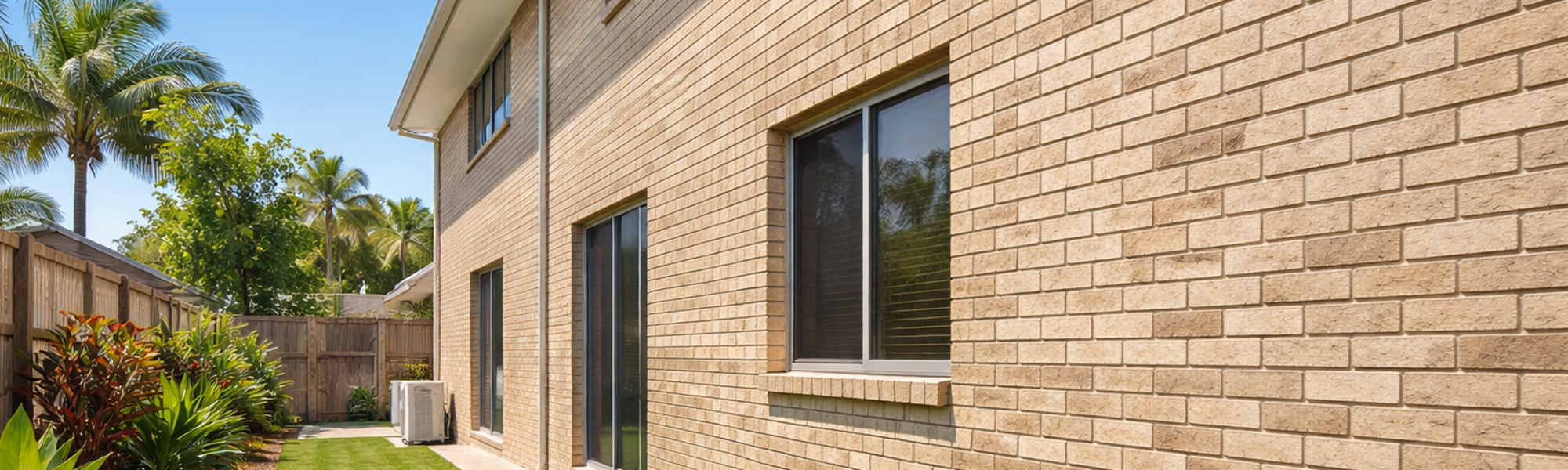
Bricks are one of the few building materials that are effectively permanent. Paint can be changed, fixtures upgraded, landscaping redone, but brickwork remains. It defines the visual identity of a house, controls how it ages, and plays a quiet but important role in thermal comfort, durability, and maintenance.
Most brick decisions are rushed. They are often made late, under showroom lighting, with a single loose sample and little understanding of how that choice interacts with structure, climate, mortar, or detailing. That approach works only by accident.
Choosing bricks well means understanding how they behave as part of a wall system, how they read at scale, and how they perform over decades, not just how they look on day one.
Structural Role Versus Appearance
In most contemporary builds, bricks are used as veneer rather than as load-bearing masonry. They form an external skin tied back to a framed structure, separated by a cavity that manages moisture and movement. Even so, veneer bricks are not merely cosmetic. They influence thermal mass, sound attenuation, durability, and weather resistance.
In double brick or cavity masonry construction, brick choice becomes even more consequential. Density, firing temperature, and absorption rates affect how the building responds to heat and moisture. Heavier bricks store and release heat slowly, moderating internal temperature swings. Lighter bricks respond faster but offer less thermal buffering.
Before choosing a colour or texture, confirm how the bricks are being used structurally. A brick that performs adequately as veneer may behave very differently when it forms both sides of a cavity or an internal structural wall.
Brick Colour and Long-Term Behaviour
Brick colour affects far more than appearance. It influences heat absorption, ageing patterns, and how forgiving the facade is over time.
Dark bricks absorb more solar heat and can significantly increase wall surface temperatures, particularly on west-facing elevations. This can affect internal comfort and cooling loads. Light bricks reflect more heat but show staining, dust, and biological growth more readily, especially in shaded or damp areas.
Mid-range colours and blended tones often age best. Variations within the brick help mask minor inconsistencies in laying, mortar variation, and surface weathering. Extremely uniform colours can look flat across large walls and highlight every imperfection.
Always assess bricks in large panels outdoors. Light, shadow, and mortar change how colour is perceived. A single showroom sample cannot represent how a facade will read across an entire building throughout the day.
Texture, Finish, and Surface Performance
Brick surface finish changes how a wall interacts with light, moisture, and dirt.
Smooth bricks create crisp, modern facades with sharp lines, but they are unforgiving. Mortar smears, alignment issues, and small chips remain visible. Textured bricks soften visual transitions and hide minor imperfections, making them more tolerant of real-world construction variability.
Heavily textured or handmade-style bricks introduce variation that adds character but can trap moisture and dust. In humid or coastal environments, this can increase surface growth if walls are shaded or poorly ventilated.
Finish should be chosen with location in mind. A brick that performs well on a sun-exposed facade may behave very differently along a narrow side boundary or under deep eaves.
Brick Size, Proportion, and Visual Scale
Standard brick sizes dominate for good reason. They integrate cleanly with typical window heights, lintel placements, and course alignment, keeping detailing simple and costs predictable.
Larger format bricks reduce the number of mortar joints and emphasise horizontal lines. They suit contemporary designs but magnify inaccuracies in laying. Smaller bricks increase visual texture and pattern density but add labour time and cost.
Changing brick size affects more than appearance. It alters how courses align with floors, windows, and rooflines. Non-standard sizes must be coordinated early in the design to avoid awkward detailing or excessive cutting.
Mortar Selection and Compatibility
Mortar is not a background element. It frames every brick.
Colour choice dramatically affects how brickwork reads. High-contrast mortar emphasises joints and pattern. Lower-contrast blends soften the facade and make walls more forgiving of minor inconsistencies.
Strength matters as much as colour. Mortar should generally be weaker than the brick so it absorbs movement and thermal expansion rather than forcing stress into the masonry. Hard mortars paired with softer bricks increase cracking risk.
Mortar choice should suit the brick type, exposure conditions, and construction method. Accepting a default mix without understanding its implications is a common and avoidable mistake.
Brick Bonds and Laying Patterns
Most homes default to stretcher bond, largely because it is efficient, economical, and familiar. That does not mean it is always the best choice.
Different bonds change how a wall reads. Some emphasise length, others height. Some highlight mortar joints, others minimise them. Pattern choice interacts strongly with brick size, colour variation, and mortar contrast.
Non-standard bonds require higher laying accuracy and experience. If precision is not achieved, visual issues become obvious very quickly. Bond selection should be made alongside brick choice and confirmed before quoting, not left to site decisions.
Cavities, Ties, and Wall Build-Up
Bricks do not perform in isolation. The cavity behind them manages moisture, ventilation, and movement.
Cavity width affects drying potential and detailing around windows and doors. Brick ties must suit the exposure level and resist corrosion. Poor tie selection can lead to long-term staining or structural issues.
Good wall systems allow moisture to drain and evaporate without being trapped. Brick choice should align with cavity design and site exposure to ensure the wall behaves as intended over time.
Control Joints and Movement Management
All brickwork moves. Expansion and contraction are normal.
Control joints manage that movement by providing deliberate locations for it to occur. Poorly planned joints lead to random cracking that draws attention and undermines confidence in the build.
Joint placement affects facade appearance. Poor positioning can visually chop walls or interrupt feature areas. Brick type, wall length, orientation, and exposure all influence joint spacing.
Control joints should be planned early and detailed deliberately, especially when using uniform bricks or tight mortar colours.
Sealing and Surface Treatments
Most face bricks do not require sealing, but some benefit from it in specific conditions.
Light-coloured, absorbent, or textured bricks near ground level or in covered outdoor areas can stain easily. Appropriate sealing can reduce maintenance without altering appearance.
The wrong sealer can cause problems by trapping moisture or changing surface sheen. Any sealing decision should be brick-specific and suited to the exposure conditions, not applied as a blanket solution.
Internal Brickwork and Feature Walls
Bricks used internally behave differently to external masonry.
They are viewed closer, under controlled lighting, and without weathering to soften the surface. Mortar lines become more prominent and surface variation more noticeable.
Bricks selected for external use may need different mortar colours or finishes internally to achieve the desired result. Internal brickwork should be mocked up and assessed separately, not assumed to work by default.
Cutting, Edge Conditions, and Detailing
The quality of brickwork is often revealed at edges rather than in the field.
Window returns, sills, corners, and parapets expose how well bricks cut and how consistent their internal colour is. Some bricks chip easily or reveal tonal differences when cut.
Good detailing minimises visible cuts and aligns brick courses with architectural elements. Poor detailing makes every compromise obvious. Edge conditions should be reviewed before finalising brick choice, not discovered on site.
Supply, Lead Times, and Future Matching
Brick supply can change quickly. Popular lines sell out, and colours are discontinued without much notice.
If a brick is central to the design, secure supply early and order sufficient quantity with contingency. Future repairs or extensions rely on matching bricks, which may not be possible later.
Keeping spare bricks on site is a simple precaution that can save significant trouble years down the track.
Compliance, Acoustic, and Site Constraints
Bricks interact with planning and regulatory requirements more than most people realise.
Boundary walls, bushfire overlays, and acoustic performance can all influence brick choice and wall construction. Denser bricks generally perform better acoustically. Some wall systems simplify compliance in regulated areas.
Brick selection rarely causes compliance failure on its own, but poor coordination can complicate approvals and detailing.
Brick Choice and Long-Term ValueBrickwork anchors the perceived age of a house. Trends date quickly when expressed in permanent materials.
Highly distinctive colours or finishes can limit future appeal, even if they feel bold at the time of construction. Bricks that sit comfortably within the local built environment tend to age more gracefully.
Choosing bricks with long-term balance rather than short-term impact usually results in better resale performance, whether or not selling is planned.
Choosing bricks is not a styling exercise. It is a systems decision that affects structure, performance, appearance, and maintenance for decades.
View bricks at scale, understand how they are laid, coordinate mortar and detailing, and consider how the wall will behave over time. When bricks are chosen well, they fade into the background and quietly do their job. When chosen poorly, they dominate every discussion about the house for all the wrong reasons.
You might also like





Disclaimer: Every effort has been made to ensure the accuracy of the information provided, but we make no guarantees regarding its completeness or reliability. The data is presented for general informational purposes only and does not constitute financial, investment, or legal advice. We are not liable for any errors, omissions, or consequences arising from its use. Users should verify details with relevant sources and seek professional advice where appropriate for the most accurate and up-to-date guidance.